

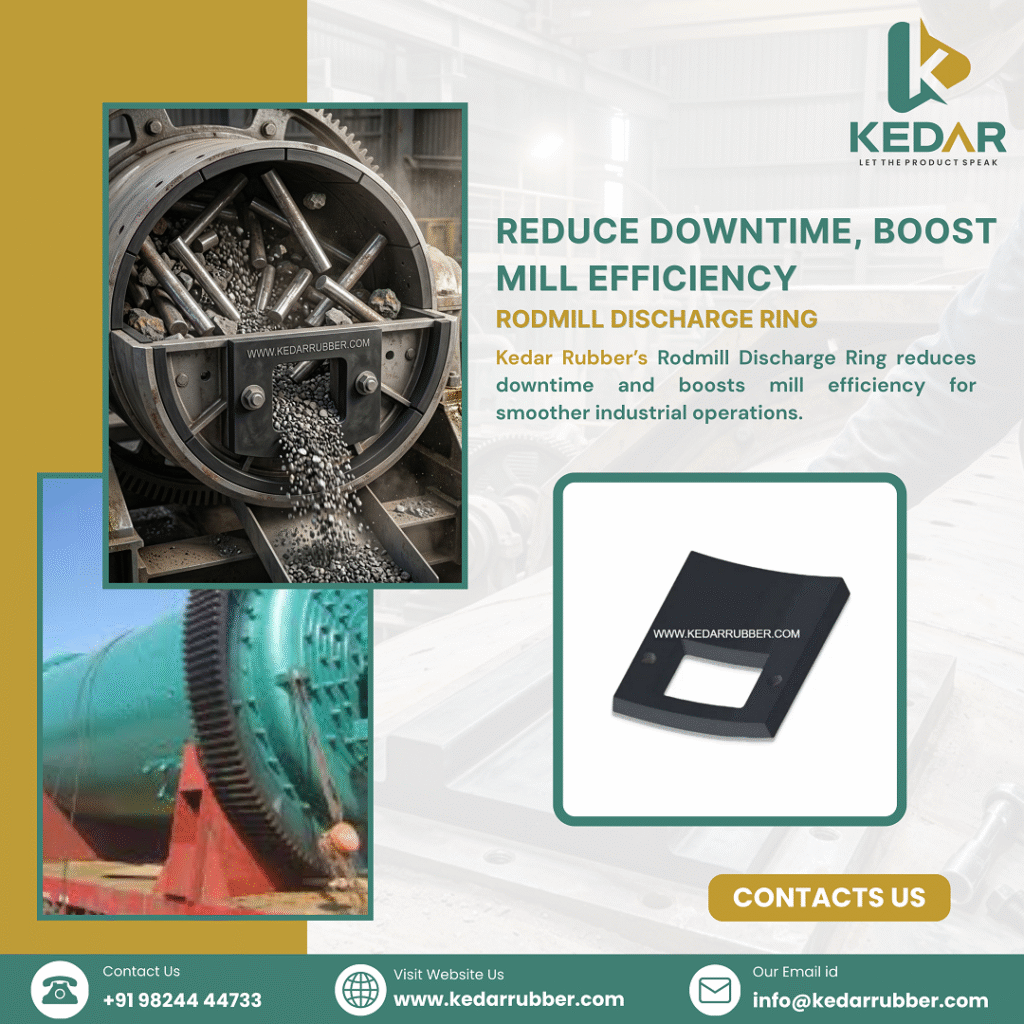
Maximize Grinding Efficiency with Advanced Discharge Ring Technology by Kedar Rubber Products Pvt. Ltd.
Improve Grinding Efficiency Using Discharge Ring Technology is becoming a critical focus in modern heavy-duty industrial operations. In sectors such as mining, cement manufacturing, metal processing, and bulk material handling, equipment is continuously subjected to extreme operating conditions. Intense impact forces, highly abrasive materials, and nonstop operational cycles create severe wear challenges that directly impact productivity and overall efficiency.
Plant engineers widely recognize that the most vulnerable points in material handling systems—particularly discharge zones—are major contributors to downtime and rising maintenance costs. These zones face a constant combination of impact stress, abrasion, and material turbulence, making them highly prone to accelerated wear and frequent failures.
Across global industries, there is a clear shift toward reliability-centered maintenance strategies that emphasize extending equipment lifespan while minimizing unexpected shutdowns. As a result, the demand for advanced, engineered wear protection solutions has significantly increased, especially those capable of performing consistently under harsh process conditions.
One of the most crucial yet often underestimated components in this context is the Rodmill Discharge Ring. It plays an essential role in controlling material flow at discharge points while safeguarding internal mill components from excessive wear—ultimately ensuring smoother operations, reduced maintenance, and improved equipment longevity.
Industrial Challenges That Drive Demand for Rodmill Discharge Ring
In mining and metal processing operations, several recurring challenges contribute to the growing need for robust discharge system components:
- Abrasion: Continuous movement of ore, clinker, or raw materials leads to surface wear. Fine particles, especially silica-rich materials, can cause rapid degradation of metal components.
- Impact Loads: Material discharge zones are exposed to dynamic impact forces due to falling and flowing materials. This repeated stress can cause cracking or deformation in poorly designed components.
- Corrosion: In wet grinding environments or chemical processing plants, corrosion further accelerates wear, especially in metallic discharge structures.
- Downtime: Frequent failures in discharge systems can halt entire production lines. Unplanned downtime in industries like cement or steel can lead to significant production losses.
- Maintenance Costs: Replacing worn-out components, labor costs, and production losses collectively increase the total cost of ownership.
These challenges are not limited to India but are widely observed in mining regions of Australia, Africa, and South America, as well as in large-scale cement and steel plants across Asia and Europe.
What Is Rodmill Discharge Ring?
A Rodmill Discharge Ring is a specialized wear-resistant component installed at the discharge end of a rod mill. Its primary function is to regulate the flow of processed material while protecting the mill structure from direct exposure to abrasive and impact forces.
It acts as a barrier between the high-energy internal grinding environment and the downstream material handling system. By controlling discharge patterns and reducing direct wear on mill shells and outlets, it contributes to improved operational stability.
Unlike standard metallic rings, modern discharge rings are often engineered using rubber or composite materials to enhance wear resistance and impact absorption.
Applications Across Industries
Rodmill Discharge Rings are widely used across multiple industries where grinding and material handling are integral processes:
- Mining Industry: Used in ore processing plants for handling materials like iron ore, copper, gold, and bauxite. Helps manage abrasive slurry discharge.
- Cement Industry: Installed in grinding mills handling clinker and raw materials, ensuring consistent discharge and reduced wear.
- Metal & Steel Plants: Supports efficient processing of raw materials and slag handling systems.
- Ceramic Industry: Useful in processing ceramic raw materials where precision and wear resistance are critical.
- Power Plants: Applied in coal grinding and ash handling systems, where abrasive particles are common.
- Bulk Material Handling: Integrated into systems dealing with large volumes of aggregates, minerals, or industrial powders.
For global industry updates and trusted international news, you can explore coverage on BBC.
Material Science & Engineering Considerations
The performance of a Rodmill Discharge Ring largely depends on material selection and engineering design.
- Rubber Properties: Rubber offers excellent impact absorption and flexibility. It can withstand repeated mechanical stress without cracking, making it suitable for high-impact zones.
- Ceramic Hardness: Ceramic materials provide superior hardness and abrasion resistance. They are often used in combination with rubber to create composite solutions.
- Wear Resistance Principles: Wear resistance is achieved by balancing hardness and elasticity. Hard materials resist abrasion, while elastic materials absorb impact energy.
- Impact Absorption: Rubber linings reduce the transfer of impact forces to the mill structure, minimizing structural fatigue.
Manufacturers with long-term industry exposure understand that selecting the right material combination is critical for optimizing performance under specific operating conditions.
Design & Customization Requirements
Every industrial plant operates under unique conditions, making customization essential.
- Equipment Compatibility: Discharge rings must align precisely with the mill design to ensure proper fitment and performance.
- Custom Sizing: Dimensions are tailored based on mill diameter, discharge opening, and material flow requirements.
- Application-Specific Design: Design parameters vary depending on whether the application involves dry grinding, wet processing, or high-impact material flow.
Manufacturing Quality & Process Control
Precision manufacturing plays a crucial role in ensuring consistent performance.
- Precision Engineering: Accurate molding and machining ensure proper alignment and structural integrity.
- Quality Checks: Products undergo rigorous inspection for dimensional accuracy, material consistency, and bonding strength.
- Batch Consistency: Maintaining uniform quality across production batches is essential for large-scale industrial applications.
Installation & Maintenance Considerations
Ease of installation and maintenance significantly impacts plant efficiency.
- Simplified Installation: Well-designed discharge rings allow quick installation, reducing downtime during maintenance shutdowns.
- Reduced Downtime: Durable materials extend service intervals, minimizing the frequency of replacements.
- Maintenance Cycles: Regular inspection schedules help identify wear patterns and prevent unexpected failures.
Looking to improve mill efficiency and reduce downtime with advanced Rodmill Discharge Rings? Contact us today for expert solutions tailored to your plant needs.
Safety & Operational Reliability
Safety is a critical concern in industrial operations.
- Worker Safety: Properly functioning discharge systems reduce the risk of material blockages and sudden failures.
- Equipment Protection: Wear-resistant components protect critical mill structures from damage.
- Plant Reliability: Consistent performance ensures stable production output and reduces operational risks.
Cost Efficiency Over Equipment Life Cycle
While initial investment is important, long-term performance defines true value.
- Long-Term Savings: Durable components reduce the need for frequent replacements.
- Reduced Shutdowns: Minimizing downtime leads to higher productivity.
- Maintenance Optimization: Lower maintenance frequency reduces labor and operational costs.
Export Readiness & Global Acceptance
Global industrial buyers expect high standards in manufacturing and documentation.
- Compliance Awareness: Products must meet international quality and safety standards.
- Documentation: Clear technical specifications and material certifications are essential for export markets.
- Global Requirements: Industries in regions like the Middle East, Africa, and Southeast Asia demand reliable and consistent wear protection solutions.
Why Experienced Manufacturers Matter?
Selecting the right manufacturer is as important as choosing the right product.
- Engineering Expertise: Experienced manufacturers understand complex industrial requirements.
- Industry Experience: Long-term exposure helps in designing application-specific solutions.
- Reliable Supply: Consistent production and timely delivery are critical for large-scale projects.
For global industrial and economic updates, you can explore international news coverage on CNN.
About Kedar Rubber Products
KEDAR RUBBER PRODUCTS PVT LTD is an experienced manufacturer specializing in wear protection and rubber lining solutions for industrial applications. The company serves a wide range of industries across India and international markets, offering engineered products designed for demanding operating conditions.
With a strong understanding of plant-level challenges and material science, the company focuses on delivering reliable and application-specific solutions.
For more information, visit: 👉 https://www.kedarrubber.com/
Conclusion:
Rodmill Discharge Rings play a vital role in protecting critical mill components and ensuring efficient material flow in high-wear environments. By addressing challenges such as abrasion, impact, and corrosion, they contribute significantly to plant reliability and operational efficiency.
In industries where downtime directly impacts profitability, investing in well-engineered discharge components is a practical and necessary decision. Choosing the right design and material, along with an experienced manufacturer, ensures long-term performance and stability.
Partner with experienced engineers for durable and high-performance discharge ring solutions—contact us now to enhance your operational reliability and productivity.
Key Takeaways
- Enhances wear protection in high-impact discharge zones
- Improves operational reliability in grinding systems
- Suitable for mining, cement, steel, and ceramic industries
- Supports long-term equipment performance
- Meets global industrial requirements for durability and consistency
Trending FAQs
Q1. What is the typical lifespan of a Rodmill Discharge Ring?
- The lifespan depends on operating conditions, material type, and maintenance practices. In well-managed systems, it can last significantly longer than traditional metallic components.
Q2. Is it suitable for both dry and wet grinding applications?
- Yes, discharge rings can be designed for both dry and wet environments with appropriate material selection.
Q3. How often should maintenance be performed?
- Routine inspections are recommended during scheduled shutdowns to monitor wear patterns and ensure optimal performance.
Q4. What is the difference between rubber and ceramic wear solutions?
- Rubber provides impact resistance and flexibility, while ceramic offers superior hardness and abrasion resistance. People often use a combination of both.
Q5. Do people use these products globally?
- Yes, industries across various global markets widely use Rodmill Discharge Rings in mining, cement, and metal applications.
#BallMillRubberLiner #CeramicWearProtection #RubberLining #MiningSolutions #BulkMaterialHandling #ConveyorSolutions #kedarrubberproduct #WearProtection #IndustrialManufacturing