Wear-Resistant Discharge Lifter Bar in Morbi for Heavy-Duty Applications: Kedar Rubber Products Pvt Ltd
In sectors such as mining, metal refining, cement production, ceramic production, and bulk material conveyance around Morbi, equipment reliability directly impacts facility availability and operational stability. Within demanding industrial settings, failures linked to material deterioration are a primary driver of unscheduled stoppages. The wear from crushed ore, clinker, slag, and raw ceramic compounds, coupled with forceful impacts within rotating machinery, causes a gradual loss of material in critical areas. Competently designed Discharge Lifter Bars in Morbi aid in directing material movement and safeguarding internal mill liners, thereby boosting operational effectiveness.
The increasing worldwide demand for minerals, structural steel, cement, and specialized ceramics continually challenges processing plants to maintain operations over extended periods with predictable service schedules. Seasoned facility supervisors frequently note that even minor wear parts, if neglected, can undermine the performance of central machinery, such as grinding mills. The Discharge Lifter Bar is one such element—a part that quietly yet crucially influences material passage, mill outlet efficiency, and the protection of the liner system.
In mining and metal processing, improving discharge processes involves more than just output volume. It has a direct bearing on liner longevity, power consumption stability, and the performance of equipment further down the line. Consequently, understanding the role and engineering of discharge lifter bars is vital for maintenance and operations personnel seeking to reduce long-term costs and enhance reliability.
Industrial Hurdles Driving the Need for Discharge Lifter Bars
Grinding mills operate under some of the planet’s most severe industrial conditions—ranging from abrasive iron ore circuits in Australia to chemically aggressive mineral suspensions in South America and high-heat clinker grinding in cement factories. These operational realities lead to persistent technical complications:
- Wear by Friction: Constant exposure to hard particulates gradually degrades the surfaces of liners and lifters.
- Impact Forces: Large incoming material sizes and tumbling media create recurring shock loads on discharge hardware.
- Chemical Deterioration: Wet slurries, processing agents, and water contribute to material breakdown.
- Operational Halts: Worn discharge parts can impede material flow, leading to blockages and forced shutdowns.
- Service Expenses: Frequent liner replacements elevate labour hours, crane use, and lost production time.
Producers with substantial industry tenure recognize that wear issues are seldom isolated. Subpar discharge performance can increase the load being reprocessed, raise mill energy usage, and hasten wear on downstream conveyors and pumps.
Defining a Discharge Lifter Bar
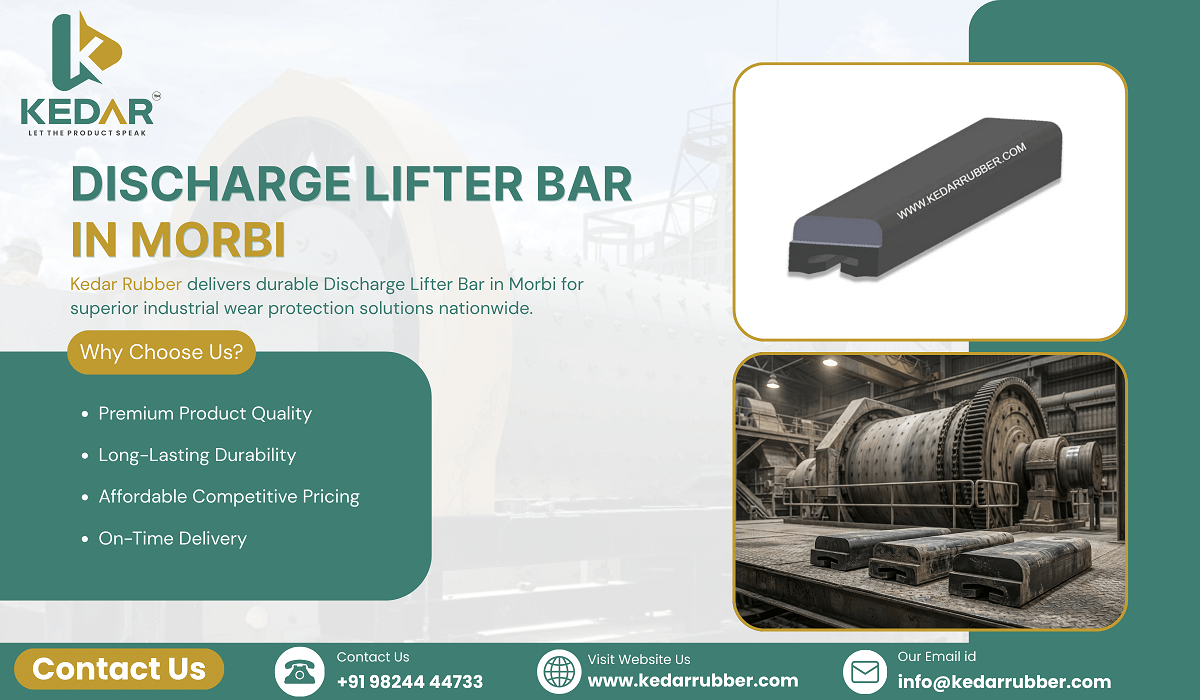
A discharge lifter bar is a replaceable part fitted in the exit section of a grinding mill. Its primary purpose is to route ground material and slurry to the mill outlet in a controlled manner. Unlike general-use lifter bars within the mill body, discharge lifter bars are specially configured to:
- Sustain a steady flow of discharged material
- Shield the mill shell and the discharge end liners from direct abrasive contact
- Back-up stable pulp lifter action in wet grinding circuits
From an engineering perspective, discharge lifter bars are an integral part of the liner setup and must be designed in harmony with the mill’s internal layout, rotation rate, and material properties. They are commonly fabricated from rubber, rubber-ceramic composites, or specialized wear-resistant polymers, depending on the severity of impact and abrasion levels.
Sector-Specific Deployments
Discharge lifter bars find use wherever grinding mills or comparable processing equipment encounter abrasive settings:
- Mining: Circuits for processing iron ore, copper, gold, bauxite, and phosphate
- Cement: Mills for raw material grinding and finished clinker grinding
- Metal & Steel: Slag milling, pellet production circuits, and mineral concentration units
- Ceramic: Alumina refinement, feldspar grinding, and preparation of ceramic inputs
- Power Generation: Grinding of coal and limestone in internal power units
- Bulk Material Handling: Supporting upstream milling systems that feed transfer points and conveyors
In heavy industrial zones, wear in the discharge area is often more pronounced than elsewhere in the mill due to slurry speed and directional flow. Selecting the appropriate lifter bar minimizes localized erosion and stabilizes discharge patterns.
Material Science and Design Factors
The effectiveness of wear protection hinges on material characteristics and how they react to operational environments:
- Rubber Attributes: Rubber liners provide excellent shock absorption and dampen noise. They perform well where impact loads are significant and abrasive wear is moderate.
- Ceramic Hardness: Ceramic inserts offer superior abrasion resistance in areas subject to heavy wear. They are suitable for fine particle grinding where sliding friction dominates.
- Wear Resistance Principles: The rate of wear is influenced by particle hardness, speed, and the pressure applied during contact. Matching materials correctly reduces surface cutting and fatigue damage.
- Impact Dissipation: Underlying elastomeric layers help spread impact energy, protecting both the liner and the mill casing.
Experienced facility engineers often find that hybrid configurations—rubber linings with ceramic wear tiles in particularly abrasive areas—can successfully balance impact resilience with abrasion resistance.
Design and Customization Needs
No two grinding circuits are identical. Discharge lifter bars must be tailored to match:
- Equipment Fit: Mill diameter, liner bolt configurations, and discharge grate structure
- Custom Dimensions: Length, profile height, and curvature adapted to the mill’s shape
- Application Context: Wet versus dry processing, slurry thickness, and media particle size
Improperly matched lifter bar shapes can disrupt the pulp flow, increase recirculation rates, and diminish grinding output. Bespoke engineering ensures uniform discharge performance without creating flow constrictions.
Manufacturing Excellence and Process Control
Dependable wear components are reliant on disciplined production methods:
- Precise Fabrication: Accurate moulding and finishing guarantee a correct fit
- Quality Verification: Dimensional checks, material trait evaluation, and bonding strength confirmation
- Batch Uniformity: Controlled compounding and curing procedures minimize performance variation
Manufacturers with a long-standing industry presence know that even slight inconsistencies in the rubber mixture or ceramic adhesion can markedly affect service life under high-stress conditions.
Fitting and Servicing Requirements
From a maintenance angle, discharge lifter bars should facilitate:
- Simple Assembly: Modular designs and standard bolt patterns streamline liner replacement tasks
- Minimized Outage Time: Predictable service life allows for scheduled shutdown planning
- Service Procedures: Compatibility with existing liner change protocols and lifting apparatus
In mining and metal processing operations, maintenance windows are frequently brief. Components that align perfectly straight away reduce remedial work and crane time.
Safety & Operational Dependability
The condition of consumable wear parts directly impacts worker well-being and facility uptime:
- Personnel Safety: Firmly attached liners reduce the hazard of part separation during operation
- Equipment Defence: Effective abrasion guarding avoids shell thinning and structural harm
- Facility Uptime: Consistent material exit minimizes jams and process interruptions
In demanding industrial settings, foreseeable wear patterns are a safety factor, beyond mere maintenance considerations.
Economic Efficiency Across the Equipment Lifespan
While individual liner elements constitute a small portion of overall facility investment, their long-term effect is considerable:
- Sustained Savings: Less frequent liner substitutions reduce associated labour and lifting costs
- Fewer Interruptions: Steady discharge performance prevents unscheduled downtime
- Maintenance Planning: Foreseeable wear enables condition-based upkeep scheduling
Wear defence solutions achieve lifespan efficiency when they align with process realities rather than standard specifications.
Export Readiness & Worldwide Acceptance
International industrial purchasers anticipate wear components to satisfy documented quality and performance benchmarks:
- Industrial Export Benchmarks: Adherence to global material and production norms
- Record Keeping & Standard Adherence: Traceability, verification reports, and quality paperwork
- Global Buyer Needs: Uniformity across shipments and technical support availability
Export preparedness reflects not only product superiority but also engineering dialogue and supply assurance.
Why Seasoned Producers Are Important
Discharge lifter bars are not generic goods. Their performance relies on:
- Engineering Acumen: Grasping mill dynamics and wear processes
- Sector Know-How: Experience with diverse ore types and running conditions
- Dependable Sourcing: Uniform manufacturing and delivery time management
Manufacturers with extensive sector knowledge realize that design flaws in discharge fittings can lead to wider operational inefficiencies.
About KEDAR RUBBER PRODUCTS PVT LTD
KEDAR RUBBER PRODUCTS PVT LTD is a seasoned industrial manufacturer specializing in ball mill rubber coverings, ceramic wear defence systems, rubber lining setups, ball mill rubber articles, and conveyor pathways. The firm supports the mining, cement, metal, ceramic, and bulk material-handling sectors across Pan India, serving industrial centers and processing hubs in all major Indian cities and regions.
With familiarity in varied operational settings and the needs of export-focused industries, the company concentrates on practical engineering, manufacturing uniformity, and wear solutions tailored to specific applications. Further details on product platforms and engineering capacities are accessible at 👉 https://www.kedarrubber.com/
Summary
Discharge lifter bars serve a vital function in sustaining steady material flow, safeguarding discharge areas, and supporting overall mill dependability. In mining and metal-refining operations, design and material choices influence lining lifespan, service intervals, and facility availability. Selecting thoughtfully engineered discharge lifter bars, produced with process awareness and industry insight, contributes to enduring operational steadiness.
For maintenance teams and project advisors, aligning wear-part design with actual operating conditions remains a practical way to boost equipment reliability without introducing unnecessary complexity.
Principal Points
- Wear defence enhances the lining’s life, and the discharge area’s dependability
- Consistent material exit supports steady mill operation
- Appropriate for mining, cement, metal, ceramic, and bulk handling sectors
- Material choice balances impact cushioning and abrasion resilience
- Worldwide industrial relevance demands uniform quality and documentation
Current Frequently Asked Questions
Q1: What is the usual operational duration for a discharge lifter bar?
Service duration varies based on ore coarseness, mill rotation speed, and slurry density.
Q2: Are discharge lifter bars suitable for both wet and dry grinding mills?
Indeed. Wet grinding circuits require profiles that manage slurry flow, while dry grinding focuses more on material conveyance and airborne particle control.
Q3: How frequently should discharge lifter bars be reviewed?
Inspection is typically coordinated with scheduled liner maintenance timelines.
Q4: How do rubber and ceramic wear solutions compare in discharge zones?
Rubber provides impact absorption and pliability. Ceramic offers greater opposition to wear.
Q5: Are discharge lifter bars utilized globally across mining ventures?
Yes. Comparable wear challenges exist in mineral processing facilities everywhere.
#BallMillRubberLiner #CeramicWearProtection #RubberLining #MiningSolutions #BulkMaterialHandling #ConveyorSolutions #kedarrubberproduct #WearProtection #IndustrialManufacturing