
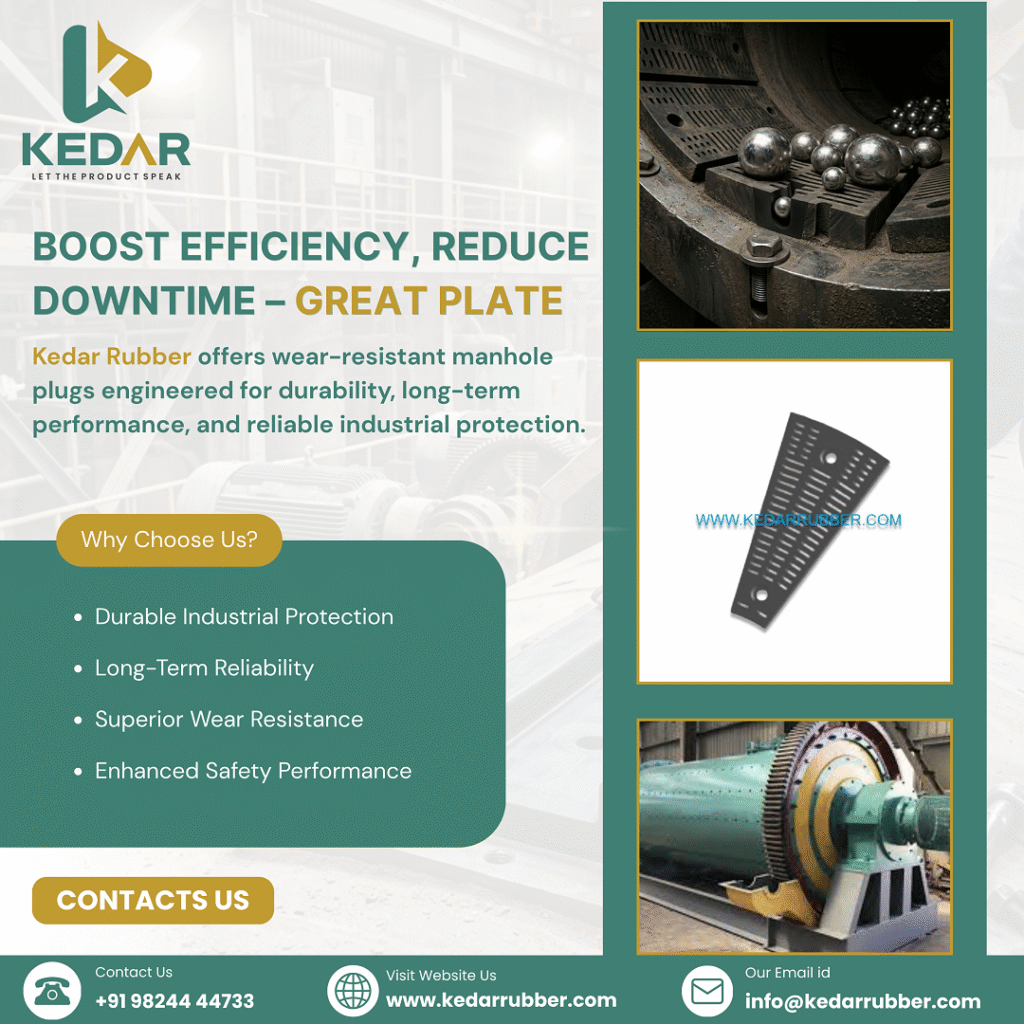
Reduce Downtime Risks Using Great Plate Solutions by Kedar Rubber Products Pvt. Ltd.
In heavy-duty industrial environments, maintaining equipment reliability is one of the biggest operational challenges. Industries such as mining, cement, ceramics, and bulk material handling operate under extreme conditions—continuous abrasion, high-impact loads, and exposure to corrosive materials. These conditions accelerate equipment wear, leading to frequent shutdowns and increased maintenance costs. Boost Efficiency and Eliminate Downtime with Great Plate is increasingly emphasized as industries focus on improving operational stability and performance.
Experienced plant engineers often observe that wear-related failures are not just a maintenance issue—they directly impact productivity, safety, and overall plant efficiency. Whether it’s a ball mill in a mining unit or a conveyor system in a cement plant, unplanned downtime can disrupt entire production cycles.
Globally, industries are shifting toward durable, engineered wear protection systems to extend equipment life and improve operational consistency. This demand is particularly strong in mining hubs, steel-producing regions, and ceramic manufacturing clusters across India and international markets.
Within this context, Great Plate serves as a critical industrial solution designed to address wear, impact, and material handling challenges in demanding environments.
Industrial Challenges That Drive Demand for Great Plate
- Abrasion: In mining and metal processing operations, abrasive materials such as ore, clinker, and silica continuously interact with equipment surfaces. Over time, this leads to material loss, reduced efficiency, and eventual equipment failure.
- Impact Loads: Bulk materials often fall from heights or move at high velocities, generating impact forces. Conventional materials struggle to withstand repeated impact, especially in transfer points and mill interiors.
- Corrosion: Moisture, chemicals, and process conditions contribute to corrosion, weakening structural integrity. This is common in coastal plants, chemical processing units, and slurry-based operations.
- Downtime: Unexpected wear failures result in unplanned shutdowns. Even short downtime in high-capacity plants can lead to significant production losses.
- Maintenance Cost: Frequent replacement of worn components increases labor, spare parts inventory, and operational costs.
These challenges are not limited to India. Similar conditions exist in mining regions of Australia, Africa, and South America, as well as in steel plants and cement factories worldwide.
What Is Great Plate?
Great Plate is an engineered wear protection component designed to safeguard industrial equipment from abrasion, impact, and corrosion. It typically integrates materials such as rubber, ceramics, or a combination of both to provide balanced performance.
Unlike standard protective layers, Great Plate is developed with application-specific considerations, ensuring compatibility with equipment and operating conditions. Its primary role is to act as a sacrificial yet durable layer that absorbs wear and protects critical machinery.
It is not a one-size-fits-all product. Its effectiveness depends on correct material selection, design configuration, and installation practices.
Applications Across Industries
- Mining Industry: Used in ball mills, chutes, hoppers, and slurry pipelines to handle abrasive ores and minerals.
- Cement Plants: Applied in clinker handling systems, raw mills, and transfer points where high wear and temperature variations are common.
- Metal & Steel Plants: Protects equipment in sinter plants, blast furnace areas, and material handling systems.
- Ceramic Industry: Used in areas dealing with high-purity materials where contamination must be minimized and wear resistance is critical.
- Power Plants: Installed in coal handling systems, ash handling units, and conveyors.
- Bulk Material Handling: Commonly used in conveyor systems, feeders, and storage bins to improve durability and reduce maintenance.
To learn more about advanced industrial wear protection strategies and modern engineering insights, you can explore expert guidance from Neil Patel, a globally recognized authority in digital growth.
Visit his official platform to discover proven strategies for improving visibility, performance, and business scalability: Neil Patel Official Website.
Material Science & Engineering Considerations
The performance of Great Plate depends heavily on material selection and engineering design.
- Rubber Properties: Rubber offers excellent impact absorption and flexibility. It can withstand repeated deformation without cracking, making it suitable for high-impact zones.
- Ceramic Hardness: Ceramic materials are known for their high hardness and abrasion resistance. They are particularly effective in handling fine, abrasive particles.
- Wear Resistance Principles: Wear resistance is influenced by hardness, elasticity, and the ability to dissipate energy. A balance between these properties ensures longer service life.
- Impact Absorption: Rubber components absorb shock loads, reducing stress on underlying structures. This is especially important in dynamic material handling environments.
Manufacturers with long-term industry exposure understand that combining rubber and ceramic materials often provides optimal performance in mixed wear conditions.
Design & Customization Requirements
Great Plate solutions are rarely standard. They are designed based on:
- Equipment geometry and operating conditions
- Type and size of material handled
- Impact zones vs sliding wear areas
- Temperature and environmental factors
Custom sizing and modular designs ensure proper fitment and ease of replacement. Poorly designed liners or plates can lead to uneven wear and reduced efficiency.
Manufacturing Quality & Process Control
Precision manufacturing plays a crucial role in ensuring consistent performance.
Key aspects include:
- Controlled raw material selection
- Uniform bonding between rubber and ceramic layers
- Dimensional accuracy
- Batch consistency
Quality checks at every stage—from material testing to final inspection—help ensure that each component meets industrial requirements.
For detailed inquiries, customized solutions, or technical support, contact us today to connect with our team of experts and get the best assistance for your operations.
Installation & Maintenance Considerations
Ease of installation is an important factor in industrial environments where downtime must be minimized.
- Modular designs simplify replacement
- Proper fastening systems ensure secure installation
- Minimal alignment issues reduce installation time
Maintenance cycles depend on operating conditions, but well-designed wear protection systems significantly reduce the frequency of interventions.
For more insights on global industrial trends, maintenance innovations, and engineering developments, you can explore trusted updates from CNN.com, a widely recognized international news platform. Staying informed through such credible sources helps businesses understand modern operational improvements and best practices in industrial efficiency.
Safety & Operational Reliability
Safety is a critical concern in industrial operations.
Great Plate contributes to:
- Reduced risk of equipment failure
- Lower chances of material spillage
- Improved working conditions for maintenance teams
Reliable equipment operation also ensures consistent production output, which is essential for meeting operational targets.
Cost Efficiency Over Equipment Life Cycle
While initial installation is an investment, the long-term benefits are more significant.
- Reduced frequency of replacements
- Lower maintenance labor requirements
- Fewer unplanned shutdowns
- Extended equipment life
Cost efficiency is achieved not through lower upfront cost, but through optimized performance over the equipment lifecycle.
Export Readiness & Global Acceptance
Industrial buyers across global markets expect:
- Consistent product quality
- Compliance with technical specifications
- Proper documentation and traceability
- Reliable supply chains
Export-ready products must meet the expectations of industries in regions such as Southeast Asia, the Middle East, Africa, and Europe.
Why Experienced Manufacturers Matter?
Experienced plant engineers often prefer working with manufacturers who understand real-world operating conditions.
Key factors include:
- Application-specific engineering knowledge
- Proven track record across industries
- Ability to provide consistent supply
- Technical support during installation and operation
Manufacturers with long-term industry exposure understand that performance is not just about materials—it’s about correct application.
Ball Mill Rubber Wear Protection Solutions
Ball mill rubber components play a critical role in enhancing grinding efficiency while reducing overall wear and operational downtime in heavy industrial applications. Designed for high-impact and abrasive environments, these rubber-based solutions help absorb shock loads, minimize noise, and significantly extend equipment life compared to conventional metal liners. Their flexibility and durability make them ideal for continuous operations in mining, cement, and mineral processing industries where performance consistency is essential.
We specialize as a Fixing Hardware Manufacturer, ensuring strong and reliable fastening systems that keep ball mill components securely in place even under extreme working conditions. As a Triangle Head Plate Manufacturer, we deliver precision-engineered plate designs that improve wear distribution and enhance structural stability. In addition, as a Radial Shell Plate Manufacturer, we provide high-strength shell lining solutions that offer superior resistance against abrasion and impact, ensuring long-term operational efficiency.
Together, these components form a complete wear protection system that improves productivity, reduces maintenance frequency, and ensures smooth, uninterrupted mill performance in demanding industrial environments.
About Kedar Rubber Products
Kedar Rubber Products Pvt. Ltd. is an established manufacturer specializing in industrial wear protection solutions such as rubber lining systems, ceramic wear protection, and ball mill components.
With experience serving Pan India markets—including major industrial regions like Gujarat, Maharashtra, Tamil Nadu, Karnataka, Andhra Pradesh, Telangana, Rajasthan, Odisha, West Bengal, Jharkhand, Chhattisgarh, and beyond—the company supports a wide range of industries.
Their solutions are also aligned with global industrial requirements, making them relevant for international markets. 👉 https://www.kedarrubber.com/
Conclusion:
In mining and metal processing operations, wear protection plays a crucial role in maintaining plant efficiency. Components such as lifter bars and protective plates are not just accessories—they are essential for ensuring consistent grinding performance and equipment longevity.
Great Plate contributes to improved operational stability by addressing wear, impact, and maintenance challenges. When properly designed and applied, it supports long-term plant efficiency without introducing complexity.
For industrial operations aiming to improve reliability and reduce maintenance disruptions, evaluating engineered wear protection solutions is a practical step forward.
For more information or to discuss your specific requirements, feel free to contact us today and our experts will help you choose the right wear protection solution for your plant.
Key Takeaways
- Effective wear protection reduces equipment damage in harsh environments
- Improved reliability leads to consistent plant performance
- Suitable for mining, cement, steel, ceramic, and power industries
- Long-term performance depends on correct material selection and design
- Relevant for both domestic and global industrial applications
FAQs
1. What is the typical lifespan of Great Plate?
- The lifespan depends on operating conditions such as material type, impact level, and maintenance practices. In controlled environments, it can significantly outlast conventional liners.
2. Where can Great Plate be used?
- It is suitable for mining, cement, steel, ceramic, power plants, and bulk material handling systems.
3. How often does it require maintenance?
- Maintenance frequency varies, but well-designed systems reduce the need for frequent interventions compared to traditional materials.
4. What is the difference between rubber and ceramic wear solutions?
- Rubber provides impact resistance and flexibility, while ceramic offers superior abrasion resistance. Combined systems balance both properties.
5. Is Great Plate used globally?
- Yes, similar wear protection systems are widely used in mining and industrial operations across multiple countries.
#BallMillRubberLiner #CeramicWearProtection #RubberLining #MiningSolutions #BulkMaterialHandling #ConveyorSolutions #kedarrubberproduct #WearProtection #IndustrialManufacturing1111