
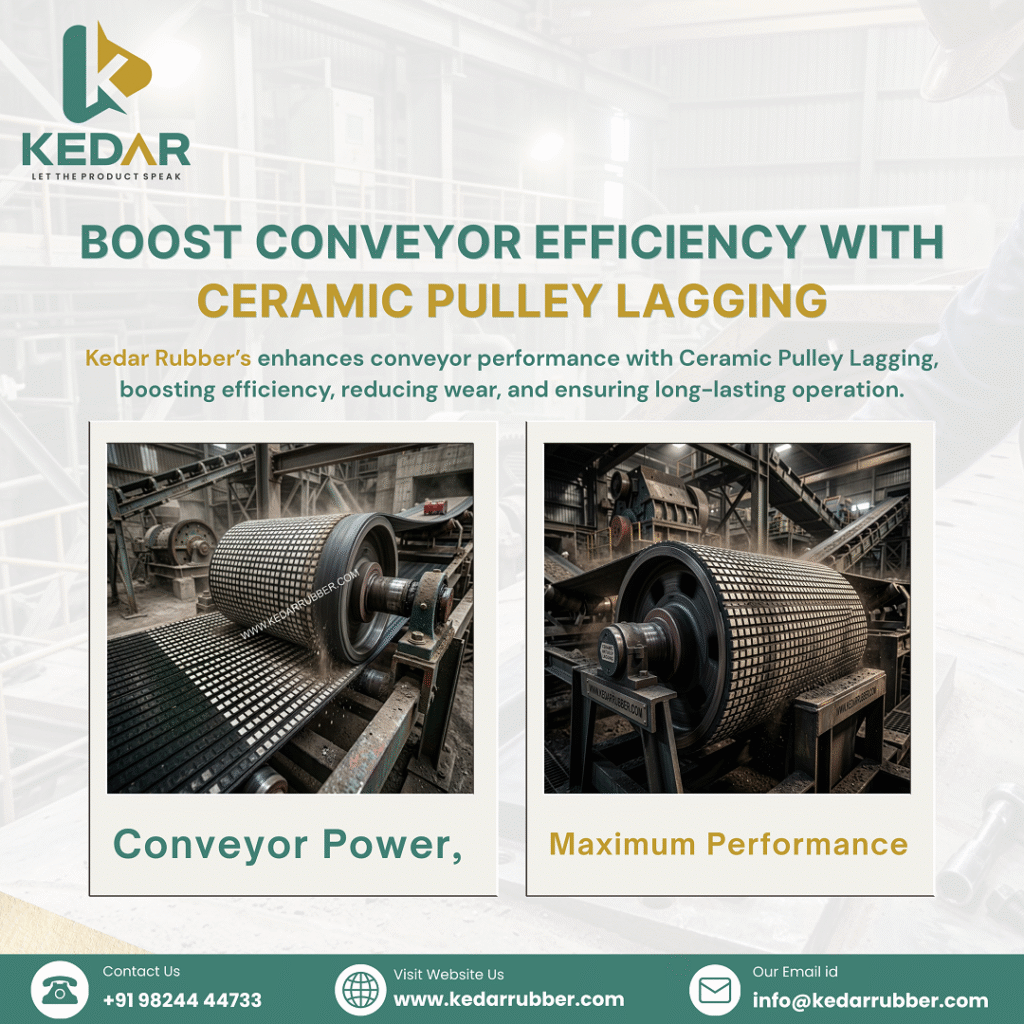
Boost Conveyor Durability with Kedar Rubber Product Pvt. Ltd. Ceramic Lagging Sheets
In bulk material handling, mining, and heavy process industries, the battle against wear is constant. Every hour a conveyor system runs under load, every ton of abrasive ore that passes over a drive pulley, and every shift that operates without inspection adds incremental stress to components that are already working at their limits.
Conveyor systems are the circulatory system of any large-scale plant — in cement manufacturing, steel production, coal handling, or mineral processing. When a pulley fails prematurely, it doesn’t just mean a replacement cost. It means unplanned shutdown, production loss, safety risks during emergency maintenance, and often, cascading damage to belts and surrounding components.
Experienced plant engineers often observe that pulley slippage, belt mistracking, and premature rubber degradation are among the most recurring operational headaches in conveyor-intensive facilities. These aren’t isolated equipment failures — they’re symptoms of inadequate surface protection under heavy-duty industrial conditions.
Ceramic Pulley Lagging Sheet has emerged as a practical, engineering-driven solution to address exactly these challenges. This blog explores the product from a plant-level perspective — what it is, where it applies, how it performs, and why the manufacturing quality behind it matters.
Industrial Challenges That Drive Demand for Ceramic Pulley Lagging Sheet
- Abrasion: In mining operations across Jharkhand, Odisha, Rajasthan, and Chhattisgarh — or in cement clusters in Andhra Pradesh and Madhya Pradesh — conveyors move materials like iron ore, limestone, coal, and clinker around the clock. These materials are inherently abrasive. Bare metal pulleys wear down quickly, and even standard rubber lagging degrades faster than maintenance cycles can accommodate.
- Impact Loads: Loading zones in bulk handling are not gentle environments. Material drops from significant heights onto moving belts, and the belt in turn transfers impact stress to the pulley face. Without adequate impact absorption, surface degradation accelerates and the underlying pulley shell can be compromised.
- Belt Slippage: Slippage between the drive pulley and the conveyor belt is a primary cause of belt wear, heat generation, and tension loss. It’s particularly acute in wet conditions, fine powder environments (common in cement and ceramic plants), or under variable load. Pulley lagging increases friction coefficient — but the type of lagging determines how well that friction holds up over time.
- Corrosion: In coastal plants, chemical processing environments, and high-humidity zones, pulley surfaces are exposed to moisture and chemical agents. Metal surfaces corrode; protective lagging prevents this from reaching the pulley shell.
- Downtime and Maintenance Cost: Unplanned conveyor shutdowns in a steel plant or a power station coal handling facility can cost significantly more than the component that failed. Maintenance teams in high-throughput operations understand that the real cost of a component is not its purchase price — it’s the cost of failure. Reducing replacement frequency and extending maintenance intervals directly improves plant economics.
What Is Ceramic Pulley Lagging Sheet?
Ceramic Pulley Lagging Sheet is a composite wear protection material bonded to the surface of conveyor pulleys. It combines a rubber backing with ceramic tiles (typically alumina-based) embedded or bonded onto the rubber surface in a defined pattern.
The rubber layer provides flexibility, bonding capability, and impact absorption. The ceramic tiles provide extreme surface hardness and wear resistance. Together, they create a lagging surface that handles both mechanical wear and operational friction demands better than plain rubber lagging or bare metal.
The sheet is manufactured in panels or rolls that are cut and fitted to the pulley circumference and face width. Depending on the application, the ceramic tile coverage, pattern, and rubber compound can vary.
This is not a universal solution that performs identically in all environments. The choice of ceramic type, tile size, pattern density, rubber hardness, and bonding method all depend on the specific operating conditions — which is why engineering input during selection matters.
Applications Across Industries
- Mining: Drive and tail pulleys in iron ore, coal, copper, and bauxite handling systems are among the most demanding applications. High tonnage, abrasive material, and continuous operation make ceramic lagging a practical choice over plain rubber in many cases.
- Cement Plants: From raw material handling to clinker conveying, cement plants in states like Rajasthan, Gujarat, Tamil Nadu, and Himachal Pradesh deal with fine abrasive dust and heavy loads. Ceramic pulley lagging on drive pulleys in these facilities helps maintain belt traction and reduces slippage-related downtime.
- Metal & Steel Plants: In integrated steel plants across Odisha, Jharkhand, West Bengal, and Karnataka, conveyor systems handle raw ore, sinter, coke, and finished products. Surface wear on pulleys in these environments is aggressive, and lagging wear life is a key maintenance metric.
- Ceramic Industry: Ceramic manufacturing clusters in Morbi (Gujarat), Khurja (Uttar Pradesh), and Thrissur (Kerala) handle bulk material for tile and sanitary ware production. Conveyor systems in these facilities benefit from lagging that resists fine particulate abrasion. Facilities in Morbi also commonly use ceramic embedded rubber liners for related wear protection applications.
- Power Plants: Coal handling plants in thermal power stations across Maharashtra, Uttar Pradesh, and West Bengal run conveyors continuously. Drive pulleys in these facilities are subject to consistent load and fine coal dust, which can be surprisingly abrasive over time.
- Bulk Material Handling: Port terminals in Mumbai, Paradip, Vizag, and Kandla handle coal, fertilizers, minerals, and grain. High humidity, salt air, and heavy tonnage make pulley wear protection critical in these environments.
Material Science & Engineering Considerations
The performance of Ceramic Pulley Lagging Sheet is directly tied to the properties of its two primary components.
- Rubber Backing: The rubber compound used in lagging must provide adequate Shore hardness for structural integrity while maintaining enough elasticity to absorb impact without cracking. Natural rubber and SBR (Styrene-Butadiene Rubber) blends are commonly used, with selection depending on temperature range, chemical exposure, and the presence of oils or solvents in the operating environment. A rubber that is too hard becomes brittle under impact; too soft, and it deforms under the ceramic tiles, reducing their effectiveness.
- Ceramic Tiles: Alumina ceramics (typically 92% or 95% Al₂O₃) are the standard for industrial lagging applications. Alumina hardness on the Mohs scale is approximately 9, making it significantly harder than most conveyed materials. This means the surface resists scratching and gouging from ore, coal, and clinker particles rather than wearing away with them.
- Wear Resistance Principles: The ceramic component resists abrasive wear; the rubber component manages impact energy. This division of function is what makes the composite more effective than either material alone. In applications with both high impact and abrasive loading, the rubber-ceramic combination typically outlasts plain rubber lagging by a significant margin.
- Bonding: The adhesion between rubber and ceramic, and between the lagging sheet and the pulley shell, is a critical manufacturing and installation variable. Poor bonding leads to tile delamination, which not only reduces effectiveness but can damage the belt. Related solutions like ceramic embedded rubber pads follow the same bonding principles and are used in complementary wear protection roles.
Design & Customization Requirements
Not every pulley lagging requirement is the same. Pulley diameter and face width vary considerably across plants and equipment generations. The lagging thickness must be accounted for in the belt take-up travel and the existing pulley-to-structure clearances.
In high-impact applications, a thicker rubber backing is preferred. In predominantly abrasive conditions with lower impact, a higher ceramic coverage ratio may be prioritized. Wet or slurry environments may call for a diamond or herringbone groove pattern cut into the lagging to channel moisture away from the belt contact zone.
Manufacturers who understand conveyor engineering can assist plant teams and procurement managers in specifying the correct lagging profile based on belt width, pulley diameter, conveyed material, load characteristics, and operating environment.
Manufacturing Quality & Process Control
The long-term performance of ceramic pulley lagging in a plant depends significantly on manufacturing consistency. Dimensional accuracy matters — even minor variations in lagging thickness across a pulley face create uneven belt loading, which contributes to mistracking and premature wear.
Quality manufacturing involves controlled rubber compound mixing, consistent ceramic tile sourcing with verified hardness specifications, precise bonding processes, and dimensional inspection of finished sheets. Batch-to-batch consistency is particularly important for facilities that maintain lagging inventory for planned maintenance cycles.
Manufacturers with long-term industry exposure understand that a single substandard batch can lead to premature field failure, which in turn erodes trust built over years. Process control in lagging manufacturing is not a formality — it directly translates into plant uptime.
Installation & Maintenance Considerations
Ceramic Pulley Lagging Sheet is typically installed using industrial adhesives or cold-bonding systems. Surface preparation of the pulley shell — cleaning, degreasing, and sometimes light abrasion — is essential for bond integrity. Technicians fit and press the lagging panels firmly, sealing the edges to prevent moisture from entering at the joints.
Installation should be done during planned maintenance windows. You must allow the lagging to cure adequately before returning the conveyor to operation under load.
In terms of maintenance, ceramic lagging generally requires periodic visual inspection for tile loss, edge lifting, or rubber cracking. A well-installed ceramic lagging on a properly sized pulley in appropriate operating conditions can last through multiple belt replacement cycles before it requires attention.
Maintenance teams should track lagging condition during belt inspections to identify wear patterns early. Localized tile loss in one area often indicates localized belt tracking issues or material spillage — addressing those root causes extends lagging life.
To improve your website rankings and keyword strategy, check expert resources by Moz.
Safety & Operational Reliability
Pulley slippage is a safety concern, not just an operational one. A slipping belt in a coal handling plant generates heat. In environments with combustible dust, that’s a risk factor. Adequate belt traction from properly installed ceramic pulley lagging reduces slippage and the associated heat generation.
Tile loss from poorly bonded lagging is another safety concern — loose ceramic fragments can damage belts, block chutes, or create foreign material risks in certain product streams. This reinforces why bonding quality in manufacturing and proper installation procedure both matter.
From a reliability standpoint, a conveyor system where pulley lagging is performing as designed operates more predictably. Belt tension remains consistent, tracking behavior is stable, and maintenance planning is easier.
Cost Efficiency Over Equipment Life Cycle
In heavy-duty industrial environments, we compare not the unit cost of a lagging sheet but the total cost over the maintenance interval. A ceramic lagged pulley that requires attention every 24 months reduces maintenance labour, shutdown frequency, and belt wear compared to a plain rubber lagged pulley that requires replacement every 8–10 months (since pulley surface degradation accelerates belt wear).
Reduced unplanned shutdowns, lower frequency of belt replacements, and fewer emergency maintenance interventions are the operational outcomes that plant engineers and operations managers value. These factors, aggregated over the life of the equipment, make the economic case for properly specified ceramic lagging without needing to rely on optimistic performance projections.
Export Readiness & Global Acceptance
Industrial buyers in export markets — whether in Southeast Asia, the Middle East, Africa, or South America — look for documentation that supports their quality assurance processes. This includes material test certificates, dimensional inspection reports, hardness data for ceramics, and adhesion test results for the rubber bonding.
Manufacturers serving global industrial clients need to operate with documentation systems that align with ISO quality management standards and can support technical data requests from procurement teams and project consultants. This is not just about paperwork — it reflects the underlying discipline of the manufacturing operation.
Why Experienced Manufacturers Matter?
There is a meaningful difference between a supplier who catalogues ceramic lagging as a stock item and a manufacturer who understands the engineering behind it. The latter can support the selection process, accommodate non-standard sizes, advise on installation method for specific pulley conditions, and provide consistent quality across production batches.
In mining and metal processing operations, plant engineers and procurement teams have learned through experience that the lowest quoted price on a wear component rarely represents the lowest total cost. A manufacturer’s track record, their understanding of application requirements, and their ability to supply reliably over time are the factors that experienced buyers weigh.
For better inbound marketing and automation strategies, explore insights from this guide on HubSpot.
About Kedar Rubber Products
Kedar Rubber Products Pvt. Ltd. is an established Indian manufacturer of rubber and ceramic wear protection solutions, serving industrial clients across mining, cement, steel, power, and bulk material handling sectors. The company produces a range of wear protection and conveyor solutions including ceramic pulley lagging, rubber lining systems, ball mill rubber liners, and conveyor components.
Operating with a focus on engineering quality and application-specific manufacturing, Kedar Rubber Products supplies clients across Pan India — from mining belts in Odisha and Jharkhand to cement plants in Rajasthan and Gujarat, steel facilities in West Bengal and Karnataka, and ceramic manufacturing clusters in Morbi and Khurja. The company also serves industrial export markets with documentation and quality systems aligned to international buyer requirements.
More information is available at https://kedarrubber.com/
Conclusion:
Ceramic Pulley Lagging Sheet addresses a real and recurring problem in conveyor-intensive industrial operations: the premature degradation of drive and tail pulleys under abrasive, high-load, and continuous-duty conditions. By combining the impact absorption of rubber with the surface hardness of alumina ceramic, it provides a wear protection solution that suits heavy industrial environments better than plain rubber lagging alone.
For plant engineers, maintenance teams, and procurement managers evaluating wear protection options for their conveyor systems, the right starting point is an honest assessment of operating conditions — material characteristics, load profile, environmental exposure, and maintenance interval targets. Properly specified and installed ceramic lagging can contribute meaningfully to conveyor reliability and reduced lifecycle maintenance cost.
If your facility is dealing with recurring pulley wear, belt slippage, or high conveyor maintenance frequency, get in touch with our team to discuss your application requirements.
Key Takeaways
- Ceramic Pulley Lagging Sheet combines rubber flexibility with ceramic hardness to handle both abrasive wear and impact loads
- Applications span mining, cement, steel, power, and bulk handling industries across India and globally
- Proper rubber compound selection and ceramic grade are critical to performance in specific operating environments
- Manufacturing consistency — dimensional accuracy, bonding quality, batch uniformity — directly affects field performance
- We compare the real cost based on lifecycle, not unit price.
- Installation quality and surface preparation are as important as product quality
- Maintenance teams benefit from a more stable, predictable conveyor system when lagging is performing correctly
- Export-market buyers increasingly require documentation and quality certifications alongside the product
Frequently Asked Questions
Q1: How long does ceramic pulley lagging typically last in a mining application?
- Service life depends on material abrasiveness, conveyor throughput, belt tension, and installation quality. In moderate to heavy-duty mining operations, well-specified and properly installed ceramic lagging commonly outperforms plain rubber lagging by a factor of 2–3 in terms of replacement intervals. Site-specific data from similar operations is the most reliable guide.
Q2: Is ceramic lagging suitable for all pulley positions on a conveyor system?
- Ceramic lagging is most commonly applied to drive pulleys, where traction is the primary function and wear is highest. Operators also use it on head pulleys in high-abrasion applications. Tail, bend, and snub pulleys may use plain rubber or grooved lagging depending on the specific wear and traction requirements at those positions.
Q3: How often should you inspect ceramic pulley lagging?
- We recommend performing a visual inspection during regular belt inspections, typically every 3 to 6 months depending on operating intensity. Inspection should check for tile loss, edge lifting, rubber cracking, and any signs of delamination. Planned maintenance windows should include a more thorough examination of lagging condition.
Q4: Can ceramic pulley lagging be customized for non-standard pulley dimensions?
- Yes. You can cut and fit lagging sheets to non-standard face widths and pulley diameters. Thickness, ceramic pattern, and rubber compound can also be specified based on application requirements. Contact our engineering team to discuss custom specifications for your application.
Q5: Is ceramic lagging used in industries outside of mining?
- Yes. Cement plants, steel facilities, thermal power stations (coal handling), port terminals, and bulk fertilizer handling operations all use ceramic pulley lagging where abrasive material and continuous-duty operation create significant pulley wear. The material type being conveyed and the operating environment determine whether ceramic lagging is the appropriate solution.
#BallMillRubberLiner #CeramicWearProtection #RubberLining #MiningSolutions #BulkMaterialHandling #ConveyorSolutions #kedarrubberproduct #WearProtection #IndustrialManufacturing