Industrial-Grade Ball Mill Rubber Liners Manufacturer: Kedar Rubber Products Pvt. Ltd.
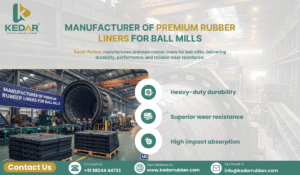
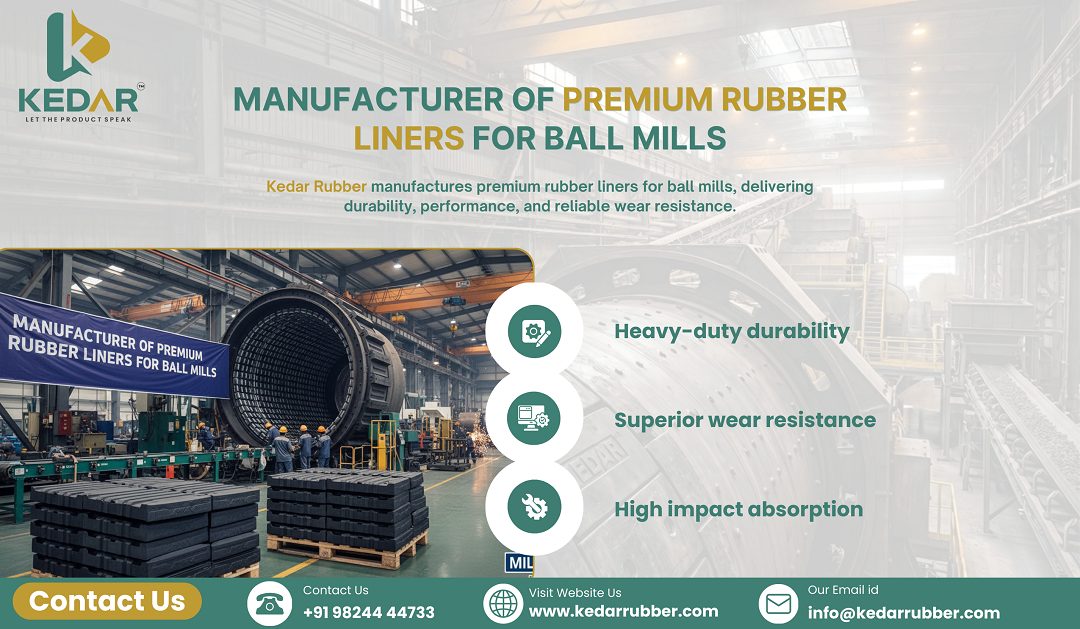
Manufacturer Of Premium Rubber Liners for Ball Mills plays a vital role in supporting industries where equipment durability defines operational success. Across mining, metal processing, cement manufacturing, ceramic production, and bulk material handling sectors, equipment reliability directly impacts plant safety, production throughput, and overall operational continuity. In these demanding industrial environments, abrasive ores, sharp clinker, high-temperature dust, and corrosive slurries constantly challenge material-handling systems, accelerating wear on mills, chutes, hoppers, pipelines, and conveyors.
Unexpected stoppages caused by lining issues, chute degradation, or material spilling from conveyors can seriously hinder production timetables and increase the burden on upkeep teams. Experienced facility engineers know that wear-related malfunctions seldom happen in easy times. More often, they arise during peak output periods, crucial shipping windows, or when upkeep resources are already strained, escalating operational and financial hazards.
As extractive work ventures deeper, ore quality decreases, and processing capacities rise globally, the need for dependable wear defence solutions keeps climbing. Rubber linings have turned into a vital industrial safeguard, shielding key process apparatus from grinding, impact, and chemical attack while fostering safer facility functions and more foreseeable, economical upkeep routines.
Operational Hurdles Fueling the Need for Rubber Linings
Industrial facilities endure severe mechanical and chemical strain. In mining and metal refinement processes, the following difficulties consistently drive the requirement for specially designed lining systems:
- Friction: Hard rock ores, minerals containing quartz, clinker, and slag cause constant surface erosion inside mills, chutes, and transfer areas.
- Impact Forces: Material drops from heights in crushers, feeders, and grinding mills create recurring impact pressures that degrade steel surfaces over time.
- Chemical Erosion: Slurries holding chemicals, dampness, and acidic byproducts hasten corrosion in pipes and containers, notably in mineral refinement and chemical processing units.
- Outages: Lining failure results in unscheduled downtime, exposing facilities to lost production hours and downstream process interruptions.
- Upkeep Expenses: Frequent lining replacements add to the upkeep workload and spare parts stock demands, especially in high-volume operations.
These issues are not restricted to one region. Comparable operating settings are encountered in Australian mining belts, South African mineral processing zones, Indian cement factories, and Brazilian steel-making centers. The fundamental wear processes remain similar, despite variations in operational settings.
What Constitutes Rubber Lining?
Rubber Linings are expertly designed protective coatings fitted inside industrial apparatus such as ball mills, chutes, hoppers, tanks, and pipework. They intend to act as a replaceable wear shield that absorbs friction, impact, and chemical exposure before the main equipment suffers harm.
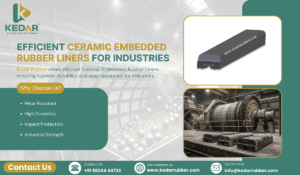
Unlike bare steel surfaces, rubber offers controlled flexibility. This flexibility enables the linings to soak up impact energy and quiet vibrations, lessening stress transmission to the equipment’s outer shell. In certain uses, rubber linings are paired with ceramic pieces to boost friction resistance in high-wear spots while preserving impact absorption in nearby sections.
Rubber linings aren’t meant to stop wear entirely; they are designed to manage wear in a projected, serviceable manner. Their success relies on suitable material selection, lining thickness, bonding techniques, and suitability for the specific operational environment.
Uses Across Different Sectors
- Mining: Ball mills, SAG mills, slurry pipelines, and ore transfer chutes benefit from rubber and rubber-ceramic lining setups that handle both the friction and the impact from hard rock feed materials.
- Cement: Clinker chutes, raw material storage bins, and grinding mills face intense friction and dust accumulation. Rubber linings reduce steel wear and quiet noise levels during material transfer.
- Metal & Steel: In steel works, linings protect bins, conveyors, and sinter handling gear from hot, abrasive materials and intermittent impact loads.
- Ceramic Production: Powder handling mechanisms and slurry reservoirs need wear-resistant surfaces to avoid contamination and equipment decay during fine material processing.
- Power Generation: Ash handling systems, coal conveyors, and slurry pipelines depend on lining systems to control erosion and prevent failures linked to chemical breakdown.
- Bulk Material Conveyance: Conveyor transfer sites, belt scrapers, and loading chutes experience continuous wear from high-volume material flow. Rubber linings help stabilize material movement and protect structural elements.
Material Science & Engineering Aspects
From an engineering viewpoint, lining performance is dictated by material science principles:
- Rubber Qualities: Natural and synthetic rubbers offer flexibility, resistance to tearing, and vibration dampening. The specific compound dictates resistance to friction, heat, and chemicals.
- Ceramic Firmness: Ceramic tiles utilized in composite linings provide high hardness for environments with extreme friction, particularly where fine mineral slurries are involved.
- Wear Resistance Concepts: Wear is affected by particle hardness, size spectrum, speed, and impact angle. Engineers match lining materials to these variables instead of relying on general specifications.
- Impact Dampening: Rubber’s elasticity lessens localized pressure points, shielding mill shells and chute frameworks from structural fatigue.
Producers with extensive industry background realize that choosing a lining isn’t about the “toughest material,” but about balancing friction resistance with energy absorption and structural fit.
Design & Customization Needs
Industrial apparatus differs significantly in shape and how it operates. Effective lining systems necessitate:
- Suitability for mill shells, chutes, and support structures
- Custom dimensions to match existing bolt arrangements and curves
- A design specific to handling wet versus dry materials
- Modular lining layouts to simplify upkeep and replacement
Poorly fitted linings create points of high stress and early failure. Design accuracy directly impacts lining lifespan and equipment defence.
Manufacturing Quality & Process Oversight
Precise manufacturing ensures linings meet size accuracy and material uniformity. Quality assurance steps typically involve:
- Verification of incoming material batches
- Regulated heating periods for rubber mixtures
- Testing adhesive strength for ceramic-rubber composites
- Dimensional checks for consistency
Uniformity across batches is especially important for large industrial orders where differing material traits can result in uneven wear patterns within the same installation zone.
Fitting & Upkeep Considerations
Ease of installation affects how upkeep is scheduled. Properly conceived lining setups:
- Allow for safe moving and placement during stoppages
- Shorten fitting duration through sectional design
- Permit predictable upkeep scheduling based on wear observation
Reduced downtime is achieved not by eliminating upkeep, but by making lining swaps a scheduled, controlled task rather than an emergency reaction.
Safety & Functional Dependability
Lining systems contribute directly to worker well-being. Rubber-covered chutes reduce material rebound and spills at transfer locations. Lower sound and vibration levels improve working conditions near mills and conveyors. Protecting the equipment also lowers the chance of major shell breaks, supporting general facility trustworthiness.
Expense Effectiveness Across the Equipment’s Lifetime
While the initial lining fitting is a planned capital expense, long-term cost benefits are realized through:
- Less equipment damage
- Fewer structural repair needs
- Foreseeable upkeep shutdown planning
- Longer service intervals for mills and handling setups
In demanding industrial settings, performance over the whole life matters more than short-term cost reductions.
Export Readiness & Global Approval
Industrial buyers in worldwide marketplaces anticipate:
- Adherence to documented material specifications
- Tracking of manufacturing batches
- Consistent quality across repeat purchases
- Technical guides for fitting and upkeep
Manufacturers focused on exporting must demonstrate process control, quality guarantee systems, and an understanding of global industrial benchmarks.
Why Do Experienced Manufacturers Matter?
Engineering skill translates to tangible lining performance. Seasoned producers grasp failure modes observed in active facilities, not just in controlled lab settings. Reliable supply chains, technical backing, and extensive industry tenure contribute to dependable lining systems that perform under real operational stresses.
About Kedar Rubber Products
KEDAR RUBBER PRODUCTS PVT LTD is a seasoned producer serving Indian and global industrial sectors with engineered Rubber Linings, ceramic wear defence solutions, rubber covering systems, ball mill rubber components, and conveyor solutions. Their work supports mining firms, cement factories, metal refiners, ceramic makers, and bulk material handling operations throughout India, including major industrial centers and regions where mining, steel, cement, and ceramic clusters are concentrated.
More details about their production capabilities and industrial uses can be found at 👉 https://www.kedarrubber.com/
Summary:
Ball Mill Rubber Linings and related wear defence setups play a fundamental part in safeguarding vital equipment across the mining, cement, metal, ceramic, power, and bulk conveyance sectors—their worth lies in managed wear control, enhanced facility dependability, and safer operating conditions. When skillfully engineered and applied, rubber lining systems become a core element of sustained facility efficiency rather than a reactive upkeep step.
For facility teams assessing wear defence plans, concentrating on application-specific design, material compatibility, and manufacturing excellence leads to more reliable operational results.
Key Takeaways
- Wear protection supports equipment longevity in abrasive industrial environments.
- Rubber liners improve operational reliability and maintenance planning
- Suitable for mining, cement, metals, ceramics, power, and bulk handling
- Performance depends on correct material selection and design
- Globally accepted solution across industrial processing sectors
FAQS
1. What is the typical service life of rubber liners in ball mills?
- Service life varies based on ore hardness, mill speed, liner thickness, and operating conditions. Wear monitoring and inspection schedules determine replacement intervals.
2. Are rubber liners suitable for high-temperature applications?
- Rubber formulations are selected based on operating temperature ranges. For elevated temperatures, composite or specialized rubber compounds are used.
3. How often should rubber liners be inspected?
- Inspection frequency depends on material throughput and wear rate. Many plants integrate liner checks into planned maintenance shutdowns.
4. When should ceramic wear protection be combined with rubber liners?
- Ceramic tiles are used in zones with extreme abrasion, while rubber provides impact absorption. Composite systems balance both requirements.
5. Do industries around the world use rubber liners?
- Yes. Mining, cement, steel, power, and bulk material handling operations worldwide widely adopt rubber and ceramic wear protection systems.
#BallMillRubberLiner #CeramicWearProtection #RubberLining #MiningSolutions #BulkMaterialHandling #ConveyorSolutions #kedarrubberproduct #WearProtection #IndustrialManufacturing