Rubber Screen in Morbi for Industrial Screening Systems: Improving Wear Resistance and Operational Reliability in Heavy-Duty Plants
Introduction
Throughout contemporary heavy sectors—especially mineral extraction, concrete aggregate production, metallurgy, and bulk cargo movement—classifiers hold a vital function in regulating particle dimension, material segregation, and overall operational effectiveness. These sectors function under stringent settings where machinery encounters rough materials, continuous pounding, and high production schedules. In centers for ceramic production like Morbi, Gujarat, the need for Rubber Screens in Morbi has grown owing to their capacity to manage corrosive feedstocks, boost sifting efficacy, and support dependable facility functions in non-stop production settings.
In demanding industrial environments, the sifting elements are among the most exposed components in the process pipeline. From ore refinement facilities to aggregate processing units and ceramic raw material preparation installations, the screening surface must endure recurring mechanical strain and the flow of abrasive substances.
Equipment dependability has emerged as a primary concern for facility planners and upkeep personnel. Even minor component malfunctions can trigger production halts, elevated running expenses, and maintenance standstills. As manufacturing capacity expands across Indian territories—from Gujarat and Rajasthan’s ceramic hubs to the mining belts in Odisha and Jharkhand—there is increasing focus on long-lasting screening remedies.
Industrial Hurdles Fueling the Uptake of Rubber Screens
Sifting apparatus in major industries must function ceaselessly while processing large quantities of feedstock hourly. This presents several engineering difficulties that influence the selection of screening material.
Friction from Hard Substances
In mining and mineral refinement operations, materials such as iron ore, limestone, coal, bauxite, and quarried stone constantly move through the screening units. These substances inflict significant abrasive wear on the screen surfaces and support frameworks.
Seasoned facility engineers frequently observe that wear brought on by friction is a leading reason for screen replacement in high-capacity processing centers.
Heavy Impact Forces
Large particle sizes and uneven material distribution can generate substantial impact stresses on screen faces. Standard metal screens often struggle to absorb repeated blows without bending or fracturing.
Degradation and Environmental Exposure
In certain processing settings—particularly at seaside facilities or those handling chemicals—the screening gear is subjected to dampness, corrosive agents, and varying heat levels. Materials must thus resist both wear and environmental decay.
Operational Stoppages
Replacing or mending a screen often necessitates halting the machinery. In continuous production setups like cement mills or steel processing units, any pause can result in substantial operational losses.
Expense of Servicing and Renewal
Frequent screen swaps inflate upkeep labor costs, spare part expenditure, and machinery idle time. Industrial installations consequently prioritize screening materials that offer a balance of resilience and ease of exchange.
These operational realities motivate the adoption of adaptable, wear-resistant screening solutions, such as rubber screens.
What Constitutes a Rubber Screen?
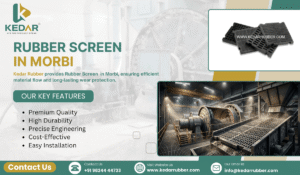
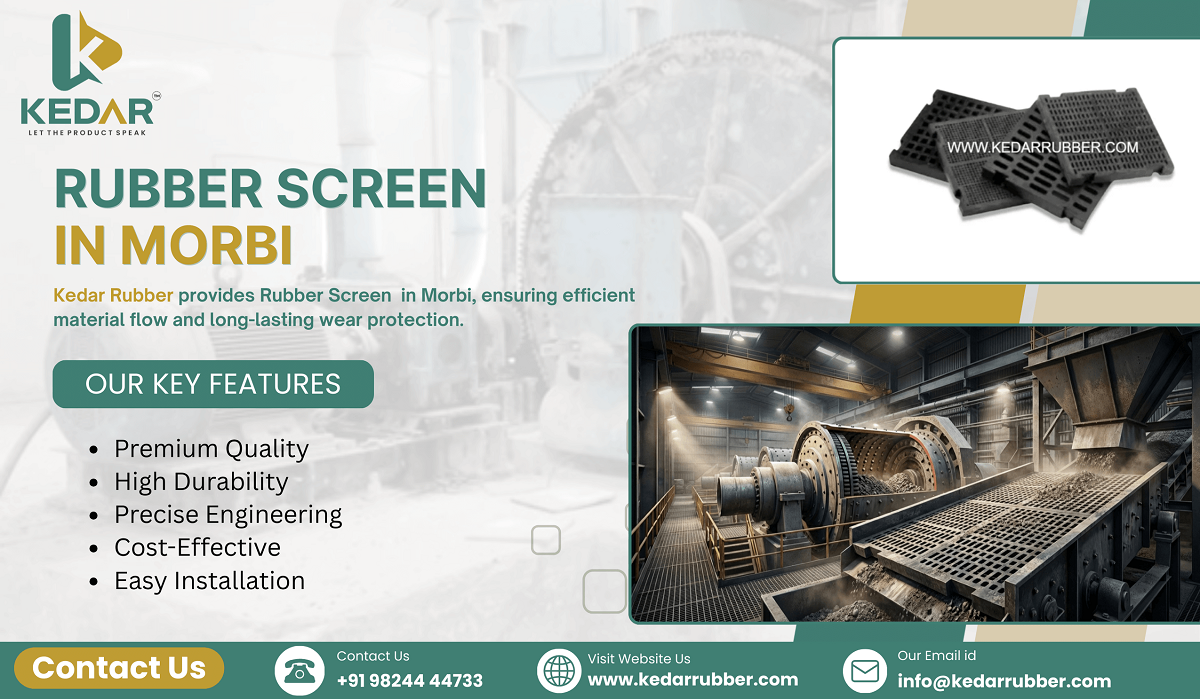
A Rubber Screen is a sieving medium fabricated from specifically formulated industrial rubber blends, intended for deployment in vibrating screens, classifiers, and separation machinery.
Unlike conventional steel or woven wire mesh screens, rubber screens are engineered to deliver a blend of pliability, resistance to abrasion, and shock absorption. They are generally fabricated as modular segments or sheets featuring orifices that permit material separation based on desired particle dimensions.
Rubber screens are routinely fitted in:
- Vibrating screening apparatus
- Mineral classification machinery
- Aggregate processing installations
- Bulk material screening setups
Their inherent flexibility enables them to handle fluctuating feed conditions while lessening strain on underlying support structures. In numerous contexts, rubber screens also contribute to diminishing noise levels and minimizing material accumulation.
Uses Across Diverse Sectors
Rubber screens find extensive use across several industrial domains where the separation of abrasive matter is a routine procedure.
Mining Sector
In mineral extraction and refinement work, rubber screens are utilized for sorting crushed ore, aggregates, and mineral concentrates. They are especially suited for managing abrasive ores like iron ore, manganese ore, and bauxite.
Mining centers throughout India—including Odisha, Jharkhand, Chhattisgarh, Karnataka, and Goa—frequently employ rubber screening solutions in ore enrichment plants.
Cement Sector
Cement mills require screening systems for feedstocks like limestone, clay, and gypsum. Rubber screens assist in maintaining uniform particle sizing while coping with the inherently abrasive nature of the raw materials.
Key cement production zones encompass Rajasthan, Gujarat, Andhra Pradesh, Tamil Nadu, and Madhya Pradesh.
Metal & Steel Facilities
Steel plants and metallurgical processing centers deal with materials such as coke, sinter, and pellets. Screening these inputs demands media capable of absorbing impact while preserving consistent openings.
Major centers for the steel industry, like Jamshedpur (Jharkhand), Rourkela (Odisha), Durgapur (West Bengal), and Bhilai (Chhattisgarh), regularly run heavy-duty screening systems.
Ceramic Manufacturing
Producers of ceramics employ screening systems to process clay, feldspar, silica, and other feedstocks vital for tile and sanitary ware fabrication.
Ceramic clusters in Morbi (Gujarat), Khurja (Uttar Pradesh), and Thangadh (Gujarat) depend on dependable screening apparatus to assure consistent raw material quality.
Power Plants
Facilities reliant on coal use screening systems for coal conditioning and ash management. Rubber screens help mitigate wear caused by abrasive coal fragments.
Bulk Material Administration
Industries involved in aggregates, fertilizers, chemicals, and food-grade minerals also deploy rubber screening panels for classification and separation tasks.
Material Science & Engineering Factors
The performance characteristics of rubber screens are largely dictated by the blend of materials and the engineering structure.
Rubber Attributes
The industrial rubber composites employed in screening panels are formulated to achieve:
- High resilience against wear
- Elastic rebound following an impact
- Resistance to tearing and distortion
- Adaptability under vibrating conditions
These qualities allow rubber screens to Center Circle, Chute Liner And Filler Block withstand repeated mechanical stresses.
Shock Assimilation
Unlike rigid metallic screens, rubber substances can soak up impact forces generated by falling material pieces. This lessens the structural burden on the screen base and its supporting framework.
Wear Resistance Theory
Abrasion occurs when hard particles slide across or strike the screening surface. Rubber’s pliable molecular arrangement permits it to diffuse energy, thereby slowing the rate of surface deterioration.
Suitability for Integrated Systems
In some high-wear scenarios, rubber screens might be paired with ceramic wear-protection elements to extend operational life in severely abrasive environments.
Layout & Customization Necessities
Screening setups vary considerably based on the facility layout, material traits, and throughput demands.
Consequently, rubber screens are typically customized according to several metrics:
- Screen opening dimensions
- Panel measurements
- Characteristics of the input material
- Type of machinery and operational vibration rate
- Processing throughput capacity
Manufacturers frequently supply modular segments or tailor-made screen sheets to guarantee integration with existing screening hardware.
Bespoke designs may additionally incorporate strengthened frameworks or specialized mounting configurations depending on the equipment setup.
Production Quality & Process Oversight
The longevity and functionality of rubber screens are highly dependent on production excellence.
Core production elements involve:
- Exact mold processes
- Managed rubber mixture composition
- Precise opening measurements
- Even panel thickness
Quality assurance protocols normally encompass:
- Checking material stiffness
- Testing resistance to rubbing
- Confirming dimensions
- Verifying batch uniformity
Sustaining uniform production ensures screen panels operate as expected across extensive industrial setups.
Setup & Upkeep Considerations
From a plant operations viewpoint, ease of mounting and serviceability are significant elements.
Rubber screens are frequently engineered with sectional attachment mechanisms permitting individual panel swaps without taking apart the whole screen apparatus.
Advantages for plant service personnel include:
- Quicker installation period
- Fewer service interruptions
- Simpler panel exchange
Service intervals generally vary based on material roughness, output volume, and working conditions.
Security & Operational Dependability
Screening setups perform in settings where worker safety and equipment trustworthiness are paramount.
Rubber screens aid safety and stable operation by:
- Decreasing machine vibration noise
- Having fewer sharp metal borders compared to steel screens
- Dampening impact forces during use
In demanding industrial settings, dependable screening systems lead to smoother facility processes and fewer equipment failures.
Value Effectiveness Across the Equipment Lifespan
Facility planners and purchasing groups frequently assess screening materials based on extended success rather than the initial cost.
Rubber screens can boost value effectiveness by:
- Lowering how often they need replacing
- Reducing the deterioration of the screening machinery structure
- Cutting short service downtime
These elements assist in optimizing equipment lifecycles and enhancing overall facility output.
Export Preparedness & International Acceptance
Industrial purchasers in worldwide markets anticipate screening components to satisfy specific quality and paperwork benchmarks.
Producers supplying rubber screening systems for overseas shipment commonly guarantee:
- Material lineage tracking
- Documentation for batch consistency
- Adherence to industrial quality norms
- Dependable packing and delivery aid
Global buyers from extraction sites, cement mills, and mineral refining sectors favor producers who can offer a steady supply and technical backing.
The Importance of Seasoned Manufacturers
Manufacturers with lengthy involvement in the sector grasp the operational hurdles faced by heavy sectors.
Experienced vendors can back industrial clientele through:
- Suggestions for designs matching specific uses
- Guidance on material choices
- Consistent product grade
- Stable manufacturing volume
Engaging with an experienced producer ensures a better match between product design and facility necessities for industrial purchasers.
Regarding KEDAR RUBBER PRODUCTS PVT LTD
KEDAR RUBBER PRODUCTS PVT LTD is an established firm focusing on industrial wear defense and rubber engineering remedies.
The firm delivers items such as:
- Mill Rubber Linings for Ball Mills
- Ceramic Wear Defense Options
- Rubber Covering Systems
- Rubber Components for Ball Mills
- Conveyor Solutions
Serving sectors throughout Pan India—including Gujarat, Maharashtra, Rajasthan, Tamil Nadu, Karnataka, Odisha, Jharkhand, West Bengal, Chhattisgarh, Andhra Pradesh, Telangana, Uttar Pradesh, Madhya Pradesh, Punjab, Haryana, Himachal Pradesh, Uttarakhand, Kerala, Bihar, Assam, and surrounding industrial zones the business partners with mining firms, cement producers, steel works, and bulk material handling sectors.
Further details are available at:👉 https://www.kedarrubber.com/
Summary
In mining and metal refinement operations, trustworthy screening assemblies play a crucial function in maintaining steady throughput and product quality.
Rubber screens offer a pragmatic answer for sectors needing tough screening material capable of managing rough elements, impact forces, and continuous use. Their capacity to soften shock, resist wear, and simplify upkeep makes them suitable for a broad array of intense industrial applications.
For facility engineers, service teams, and purchasing specialists, selecting the correct screening option directly contributes to better operational steadiness and long-term equipment performance.
Main Takeaways
- Rubber screens deliver effective resistance to wear in abrasive material handling settings
- Flexible rubber mixtures take in impact loads better than rigid screening materials
- Appropriate for mining, cement, metal, ceramic, and bulk material sectors
- Helps boost facility dependability and decrease equipment idle time
- Engineered for sustained performance in rigorous industrial activities
Trending FAQs
1. What is the typical lifespan of a rubber screen in industrial applications?
- The lifespan of a rubber screen depends on factors such as material abrasiveness, throughput volume, and operating conditions.
2. Are rubber screens suitable for mining operations?
- Yes. Rubber screens are widely used in mining and mineral processing plants for screening abrasive materials like iron ore, coal, limestone, and aggregates.
3. How often do rubber screens require maintenance?
- Routine inspection is recommended during scheduled equipment maintenance cycles.
4. How do rubber screens compare with ceramic wear solutions?
- Rubber screens are designed primarily for flexible screening applications, while ceramic wear solutions are typically used for high-abrasion protection.
5. Are rubber screens used in international industrial plants?
- Yes. Rubber screening panels are commonly used in mining, cement, and aggregate processing plants worldwide.
#BallMillRubberLiner #CeramicWearProtection #RubberLining #MiningSolutions #BulkMaterialHandling #ConveyorSolutions #kedarrubberproduct #WearProtection #IndustrialManufacturing