
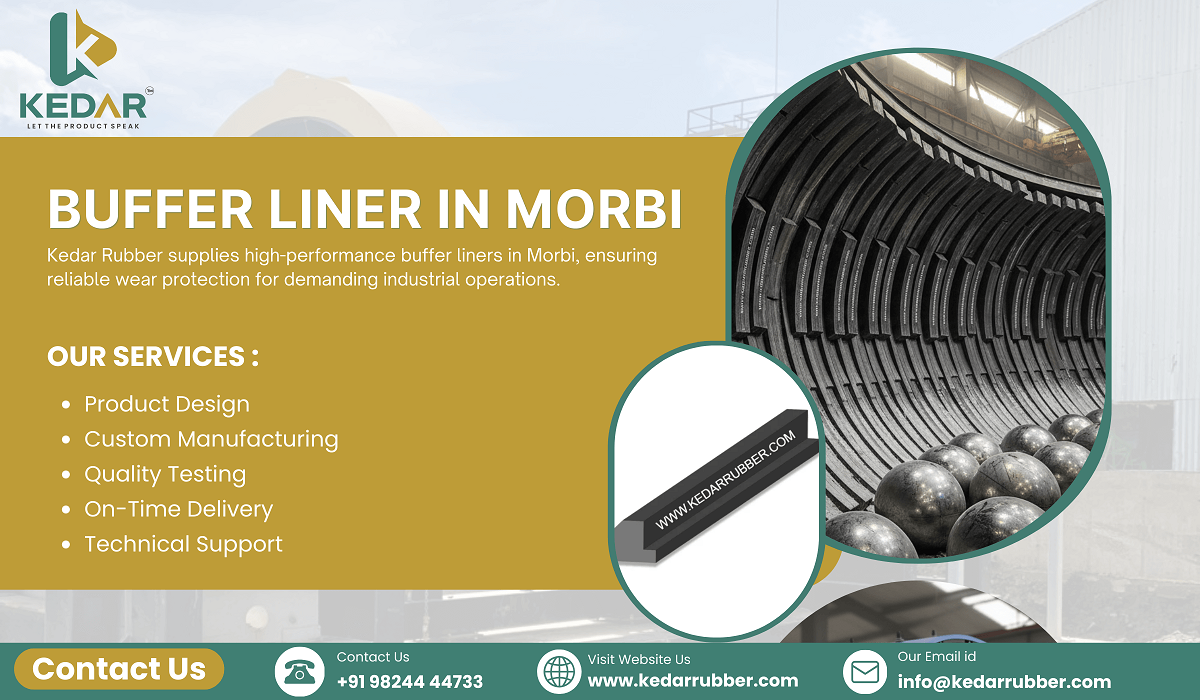
Buffer Liner in Morbi for Reliable Wear and Impact Protection in Industrial Operations: Kedar Rubber Products
Heavy industry settings subject machinery to constant mechanical stress, abrasive substances, impact forces, and harsh operational environments. Sectors like mining, metalworking, cement production, ceramics, and bulk material transport run equipment under stress that rapidly increases wear and shortens operational lifespan. Buffer Liners in Morbi protect machinery from impact and wear during demanding industrial tasks.
Plant management and maintenance staff constantly strive to improve equipment reliability while managing maintenance costs and unexpected downtime. As global industrial needs grow—especially in mineral extraction, infrastructure building, and process manufacturing—the emphasis has shifted from fixing breakdowns to implementing proactive wear defence tactics.
Wear defence is now about more than just extending component life; it directly influences process safety, steady output, and long-term asset value. Among the protective measures used industry-wide, Buffer Liners have become a vital factor in managing shocks, lessening abrasion, and safeguarding structural surfaces.
A Buffer Liner acts not merely as an upgrade but as a functionally engineered part designed to absorb energy, moderate material aggressiveness, and stabilise operation in areas subject to heavy wear.
Operational Hurdles Driving Buffer Liner Demand
Industrial facilities in major mining zones, cement hubs, steel corridors, and ceramic manufacturing areas face common operational difficulties:
- Abrasion: Commodities like ore, clinker, limestone, slag, coal, and ceramic media continually erode surfaces. Even though steel degrades fast without suitable protective coverings.
- Impact Loads: Transfer points, feed chutes, mills, and hoppers undergo repeated high-energy jolts. In time, these forces distort structures and start fractures.
- Corrosion: Moisture, chemicals, and process additives promote rust, particularly in wet grinding, slurry movement, and chemical processing settings.
- Downtime: Sudden liner failure causes unplanned shutdowns. In mining and metal operations, downtime immediately equals lost output.
- Maintenance Expense: Frequent liner replacement increases labour requirements, spare parts inventory costs, and the complexity of maintenance planning.
Seasoned plant engineers often observe that uncontrolled wear in one spot results in subsequent failures elsewhere in the system. Buffer Liners address this by serving as a managed energy-absorbing interface between material flow and the machine structure.
Defining a Buffer Liner
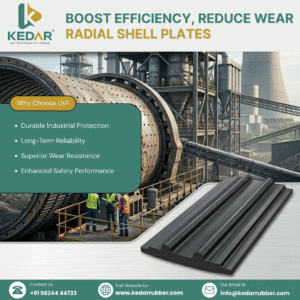
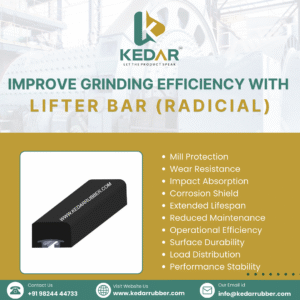
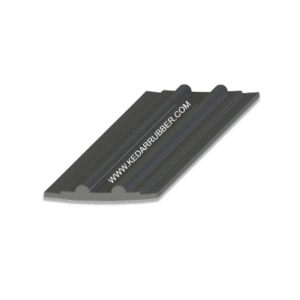
A Buffer Liner is a specialised wear protection covering primarily engineered to absorb impact energy while providing decent abrasion resistance. It is typically made from premium rubber compounds or rubber-ceramic blends, depending on the severity of the operating conditions.
Unlike liners solely focused on abrasion, a Buffer Liner prioritises:
- Shock dampening
- Noise reduction
- Structural safeguarding
It operates as a shield, minimising the direct force transferred to steel casings, chutes, enclosures, and conveyor frameworks. In numerous setups, Buffer Liners are paired with ceramic or metal liners to balance impact tolerance and lifespan.
Industry-Specific Uses
Mining Sector
Buffer Liners see broad use in:
- Mill feed sections
- Transfer chutes
- Siping (Skirt boards)
- Ore transfer systems
They mitigate linear cracking and shell damage from large falling rocks.
Cement Production
In cement grinding and material transport:
- Clinker feed areas
- Pre-grinding chambers
- Hopper impact zones
Buffer Liners help smooth material movement and guard downstream wear surfaces.
Metal & Steel Facilities
Steel mills utilise Buffer Liners in:
- Sinter material handling
- Slag transfer setups
- Coke processing units
They shield structural steel from impact deformation.
Ceramic Manufacturing
Handling raw ceramic materials requires controlled shock:
- Spray dryer input systems
- Mill inlets
- Powder transfer conduits
Buffer Liners prevent contamination and equipment harm.
Power Generation
Coal handling and ash removal systems depend on impact management:
- Storage bunkers
- Transfer stations
- Ash collection bins
- Bulk Material Handling
Conveyors, chutes, and loading stations across ports, storage facilities, and processing plants benefit from shock-absorbing linings.
Material Science & Engineering Factors
The effectiveness of a Buffer Liner heavily relies on the material mix and the quality of adhesion.
Rubber Characteristics
Highly elastic rubber blends are chosen for:
- Energy absorption capabilities
- Resistance to tearing
- Endurance against fatigue
Natural rubber and enhanced elastomers are frequently used where impact is more significant than surface wear.
Ceramic Integration
In areas with intense wear, ceramic pieces might be embedded in rubber matrices. Ceramic hardness provides abrasion resistance, while the rubber absorbs shock.
Wear Resistance Concepts
Wear levels are affected by:
- Particle size
- Angle of impact
- Speed
- Material toughness
Buffer Liners are engineered to manage these variables rather than eliminate wear.
Impact Damping
The main engineering objective is to gradually disperse kinetic energy, preventing force concentration on the steel framework.
Manufacturers with extensive field experience know that choosing the wrong material leads to liner separation and early failure.
Design & Customisation Needs
No two operational sites are exactly alike. Buffer Liners must be designed based on:
- Equipment layout
- Material properties
- Impact location
- Access for maintenance
Custom sizing ensures a precise fit without requiring excessive on-site modification. Thickness, rubber firmness, and ceramic layout are adjusted to meet specific job demands.
Manufacturing Excellence & Process Oversight
Precise manufacturing is key to liner dependability.
Key checks in the process include:
- Consistency of the rubber compound
- Controlled curing (vulcanisation)
- Accurate placement of tiles (for composite liners)
- Bond strength validation
Batch uniformity guarantees predictable field results across multiple installations.
Installation & Upkeep Notes
Buffer Liners are engineered for:
- Straightforward bolting or adhesive application
- Minimal time required for fitting
- Compatibility with existing structures
Simplified installation helps reduce the duration of operational halts. Maintenance personnel benefit from scheduled inspection periods instead of reacting to emergency repairs.
Safety & Reliable Operation
Safety directly correlates with wear management.
Buffer Liners:
- Diminish material escaping due to structural flaws
- Reduce noise and vibration levels
- Decrease the likelihood of structural failure
Consistent equipment function enhances plant dependability and overall personnel safety.
Long-Term Cost Advantage
While initial liner selection necessitates engineering assessment, the extended advantages comprise:
- Extended service life for equipment
- Fewer instances of operational halts
- Reduced costs for structural upkeep
Lifetime cost optimisation, rather than upfront savings, drives the adoption of Buffer Liners.
Global Market Readiness
Industrial purchasers in worldwide sectors expect:
- Precise dimensions
- Material lineage proof
- Uniform quality records
Exporters possess knowledge of international benchmarks, packaging mandates, and the application documentation vital for worldwide acceptance.
The Importance of Proven Manufacturers
Buffer Liners are more than just standard rubber sheeting. Their effectiveness hinges on:
- Grasp of the specific use case
- Sound engineering judgment
- Dependable manufacturing processes
Seasoned producers account for actual operational settings rather than purely theoretical lab results.
About KEDAR RUBBER PRODUCTS PVT LTD
KEDAR RUBBER PRODUCTS PVT LTD is a seasoned industrial producer focused on wear defence and material handling remedies for the mining, cement, metal, ceramic, power, and bulk handling sectors.
Serving all of India, the firm aids industrial activities in all central provinces and industrial hubs, including Gujarat, Maharashtra, Rajasthan, Odisha, Chhattisgarh, Jharkhand, Karnataka, Tamil Nadu, Andhra Pradesh, Telangana, Madhya Pradesh, Uttar Pradesh, West Bengal, Punjab, Haryana, and extending beyond, covering key industrial centres nationwide.
With hands-on engineering acumen and a process-focused production approach, the firm serves both national and international industrial arenas.
Further specifics found at 👉 https://www.kedarrubber.com/
Summary
Buffer Liners are crucial for managing impact, safeguarding machinery, and boosting plant stability in harsh industrial settings. Their merit isn’t in eradicating wear, but in handling it strategically.
When properly designed and implemented, Buffer Liners contribute to safer processes, extended equipment duration, and steady production outcomes across sectors.
Key Takeaways
- A potent solution for impact and wear control
- Boosts equipment dependability
- Applicable across various heavy industries
- Aids in long-range upkeep planning
- Demonstrated utility in global industrial settings
Current Frequently Asked Questions
1. What is the expected duration of service for a Buffer Liner?
Service length varies based on impact intensity, material composition, and operational environment, not fixed timeframes.
2. Where are Buffer Liners usually placed?
In areas subject to high impact, like receiving points, chutes, and transition zones.
3. How frequently do Buffer Liners need servicing?
Inspection periods generally align with scheduled downtime.
4. Rubber versus ceramic wear defences—what sets them apart?
Rubber dampens impact; ceramics resist surface erosion. Both are used in many installations.
5. Are Buffer Liners employed internationally?
Yes, spanning the mining, cement, power, and bulk handling sectors globally.
#BufferLiner #BallMillRubberLiner #RubberWearLiner #CeramicWearProtection #RubberLiningSystems #ImpactResistantLiner #WearProtectionSolutions #MiningWearParts #CementPlantWearSolutions #SteelPlantLiners #kedarrubberproduct