
Rodmill Discharge Ring in Morbi: A Critical Component for Wear Protection and Operational Stability in Heavy Industrial Processing
Introduction
In present-day industrial settings, the dependability of machinery profoundly impacts output targets, upkeep expenses, and overall site safety. Sectors like quarrying, cement making, metal refinement, ceramics, and bulk material transport rely heavily on crushing and milling gear to process raw stock at high volumes. In ceramic production centers such as Morbi, the need for resilient parts like the Rodmill Discharge Ring in Morbi has grown, as these elements facilitate smooth material exit while shielding mill frameworks from constant wear and operational strain.
Nevertheless, these processes occur under exceptionally taxing circumstances. Equipment is constantly subjected to grinding mineral fragments, heavy impact forces, high rotational energies, and continuous material movement. Without appropriate wear guarding and robust parts, mill setups can endure frequent breakdowns, significant idle time, and expensive repair actions.
Producers with extensive sector history recognize that appropriately engineered exit components significantly affect total mill efficiency and equipment service life.
Industrial Hurdles Prompting a Need for Rodmill Discharge Rings
Grinding frameworks in industrial facilities function under extremely severe conditions. Rod mills, frequently utilized for crushing ores and minerals, continuously process abrasive substances that create intense wear scenarios.
Abrasion
A major difficulty stems from the ongoing wear caused by mineral particles. In mining and metalworking uses, ores like iron, copper, and bauxite possess sharp and hard pieces that gradually wear down internal mill mechanisms.
Impact Loads
Grinding media and larger particle chunks generate recurring impact forces during mill activity. These stresses can harm poorly conceived exit elements and lead to structural failure.
Corrosion
In numerous capacities, processed substances contain moisture, chemicals, or reactive minerals. These factors can hasten the rusting of exposed metallic surfaces, particularly in damp or chemically active surroundings.
Downtime Risks
Unforeseen wear failure in crushing equipment can trigger sudden mill stoppages. For industries running non-stop production, even brief pauses can disrupt supply chains and lower productivity.
Maintenance Expenditures
Frequent swapping of degraded parts results in larger maintenance budgets, costs for spare inventory, and labor needs.
These issues are widespread in industrial settings globally—from mineral recovery operations in extraction zones to cement factories and bulk material conveyance structures.
Defining the Rodmill Discharge Ring
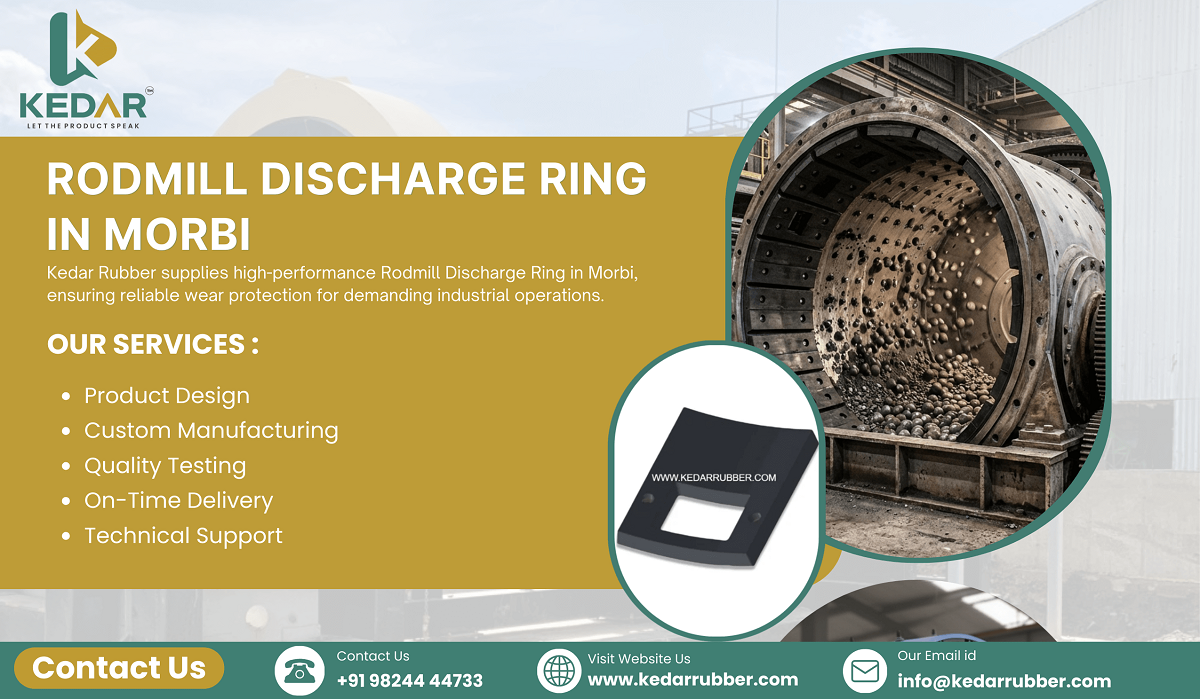
A Rodmill Discharge Ring is a specialized component resistant to wear, fitted at the exit point of a rod mill. Its main purpose is to support regulated material passage while defending adjacent mill structures from abrasive deterioration.
This discharge ring forms part of the mill’s inner surfacing system and acts as a protective shield between treated material and vital structural parts.
Practically speaking, the discharge ring aids in directing ground material out of the mill while absorbing mechanical stresses imposed by turning rods, mineral fragments, and consistent material flow.
Unlike basic metal pieces, contemporary discharge rings frequently integrate engineered rubber or composite substances intended to offer enhanced resistance to wear and dampening of shocks.
Utility Across Various Sectors
Rod mill grinding setups see broad utilization across several heavy industries where vast volumes of raw matter need efficient processing.
Mining Sector
Extraction activities employ rod mills for the initial crushing of ores before subsequent treatment. The discharge ring holds a crucial role in managing the exit of processed material while safeguarding mill frameworks from abrasive harm.
Cement Production
In cement works, grinding systems handle clinker and raw ingredients for cement creation. The discharge ring aids in guaranteeing steady expulsion of ground matter while minimizing internal deterioration.
Metal and Steel Processing
Metal refinement facilities often use crushing machinery for ore preparation and slag handling. Durable exit components are vital for sustaining equipment stability under heavy output demands.
Ceramic Manufacturing
Ceramic producers depend on precise grinding setups to prepare primary materials such as feldspar, quartz, and clay. Regulated exit flow supports consistent particle dimensions needed for ceramic output.
Power Stations
Thermal power facilities managing coal or mineral-based fuel frequently require grinding apparatus for fuel preparation. Dependable exit parts contribute to uninterrupted service.
Bulk Material Conveyance Frameworks
Industries managing large quantities of minerals, aggregates, and industrial substances rely on crushing equipment integrated with conveyor systems and material transfer networks.
Material Science & Engineering Aspects
The efficacy of a rodmill discharge ring is largely contingent upon the substances composing it.
Rubber Characteristics
Rubber substances utilized in mill components supply superb shock absorption and pliability. In crushing settings where recurring mechanical pressures arise, rubber helps diffuse energy and lessen structural strain.
Rubber also exhibits resilience against many chemical settings commonly encountered in mineral processing.
Ceramic Hardness
Ceramic substances are recognized for their exceptionally high levels of hardness. When employed in wear defense schemes, ceramics offer superior opposition to abrasive mineral components.
Ceramic-clad elements are especially effective in uses involving highly erosive ores.
Wear Resistance Concepts
Solutions for wear protection must address three principal modes:
- Abrasive deterioration
- Impact wear
- Chemical breakdown
Engineers create discharge rings using materials that strike a balance among these resistance qualities.
Impact Dampening
In grinding mills, impact forces generated by rotating rods and material movement necessitate materials capable of absorbing mechanical jolts without fracturing or distortion.
Rubber-based systems frequently offer an optimal equilibrium between suppleness and longevity.
Design & Customization Needs
Every industrial mill operates under distinct parameters. Elements such as mill scale, type of grinding media, material properties, and processing throughput all influence discharge ring configuration.
Consequently, rodmill discharge rings are generally tailored according to the specific needs of the application.
Key design focal points encompass:
- Compatibility of the equipment with existing mill structures
- Accurate size tolerances
- Bespoke rubber or composite material formulations
- Adjustment for differing mill architectures
- Integration with internal lining assemblies
Manufacturers possessing substantial sector expertise comprehend how slight design alterations can significantly affect component performance.
Production Quality & Process Oversight
The longevity of heavy-duty usage parts hinges on production exactness and process regulation.
Dependable output usually entails:
- Regulated rubber mixing procedures
- Accurate shaping methods
- Verification of precise dimensions
- Testing material firmness and resilience
- Checks for consistency between production lots
Sustaining uniform material attributes across production runs is vital for guaranteeing predictable wear performance in tough plant settings.
Quality assurance protocols also help verify that every Wear Resistant Rubber Liners, Corrugated Rubber Liner And Lifter Bar(Trapezoidal) discharge ring fulfills the functional demands of the industrial crushing apparatus.
Setup & Servicing Guidelines
Rodmill exit rings are usually conceived for simple mounting during planned mill service stoppages.
Seasoned facility engineers often note that well-conceived parts lessen setup duration and minimize the need for alignment corrections.
Servicing aspects involve:
- Routine examination for deterioration
- Coordination with liner replacement timetables
- Tracking of discharge material movement
Well-conceived discharge rings can function across extended maintenance intervals before needing renewal.
Workplace Safety & Operational Dependability
Worker well-being is always a prime concern in rigorous industrial settings.
Deteriorated or compromised grinding equipment elements can trigger unforeseen malfunctions, resulting in safety risks and apparatus harm.
Robust discharge rings enhance facility safety by:
- Averting structural harm to mill assemblies
- Maintaining a steady material outflow
- Reducing the likelihood of sudden part failure
Consistent functioning boosts not only equipment service life but also overall facility trustworthiness.
Value Over the Equipment’s Lifetime
Although wear parts constitute a minor element of total equipment outlay, their effectiveness materially impacts operating expenditures.
Appropriately engineered discharge rings aid in boosting long-term value by:
- Decreasing unplanned mill downtimes
- Reducing the regularity of required servicing
- Limiting harm to adjacent mill components
- Improving the dependability of the grinding setup
Across the entire service span of grinding apparatus, these functional benefits translate to noticeable cost reductions.
Global Trade Preparation & International Acceptance
Industrial procurement specialists in worldwide marketplaces anticipate manufacturers to meet rigorous quality and documentation benchmarks.
Components ready for international shipment typically mandate:
- Thorough technical descriptions
- Records for material lineage
- Reports from quality evaluations
- Uniform production benchmarks
Nations with substantial mining and industrial processing sectors often favor providers exhibiting dependable engineering skill and consistent product caliber.
The Importance of Experienced Producers
Fabricating wear-resistant parts for grinding machinery demands specialized technical acumen.
Manufacturers with a lengthy industry background grasp:
- The mechanics of grinding systems
- How materials degrade over time
- The specific design needs of industrial sites
- The necessity of a reliable supply for service schedules
Seasoned manufacturers also collaborate closely with facility engineers, maintenance crews, and project advisors to guarantee parts meet operational benchmarks.
Regarding KEDAR RUBBER PRODUCTS PVT LTD
KEDAR RUBBER PRODUCTS PVT LTD is a seasoned industrial fabricator specializing in protection against wear for demanding processing settings. The firm supports sectors like mining, cement production, metal refining, ceramics, and bulk material transit with custom-engineered rubber and ceramic protection arrangements.
Leveraging substantial involvement serving industrial arenas throughout India and internationally, the company centers on delivering dependable answers tailored for real-world plant usage.
Further insights into their engineering capabilities and product portfolio are available at:👉 https://www.kedarrubber.com/
Summary
Grinding setups remain fundamental to numerous industrial output workflows, especially in domains handling mineral extraction, raw material preparation, and bulk product movement.
Within these setups, elements like the Rodmill Discharge Ring fulfill a crucial function in ensuring smooth material passage while safeguarding vital mill structures from abrasive damage.
Core Takeaways
- Rodmill discharge rings shield grinding mill exit areas from friction and impact degradation
- Correct engineering enhances operational reliability in severe industrial settings
- Rubber and ceramic compositions offer proven solutions for resisting wear
- Suitable for the mining, cement, metal, ceramic, and bulk handling sectors
- Long-term equipment safeguarding improves facility upkeep efficiency and dependability
Trending FAQs
1. What is the typical lifespan of a rodmill discharge ring?
- The lifespan depends on material type, ore abrasiveness, and operating conditions.
2. Can rodmill discharge rings be customized for specific mill designs?
- Yes. Most industrial mills have unique dimensions and operating conditions, so discharge rings are typically custom-designed to ensure proper compatibility and performance.
3. How often should rodmill discharge rings be inspected?
- Experienced plant engineers recommend inspecting discharge components during planned mill shutdowns or liner replacement intervals to monitor wear patterns.
4. What is the difference between rubber and ceramic wear protection?
- Rubber materials provide impact absorption and flexibility, while ceramic materials offer superior hardness and abrasion resistance.
5. Are rodmill discharge rings used globally?
- Yes. Rod mills are widely used in mining, cement, and mineral processing industries worldwide.
#BallMillRubberLiner #CeramicWearProtection #RubberLining #MiningSolutions #BulkMaterialHandling #ConveyorSolutions #kedarrubberproduct #WearProtection #IndustrialManufacturing