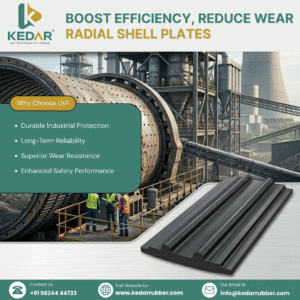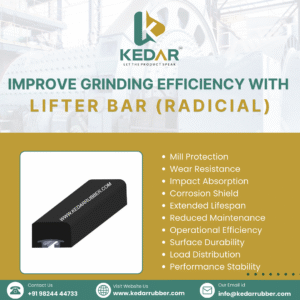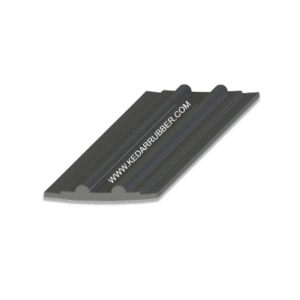
Operating a ball mill in the cement or mining industry comes with a familiar set of daily challenges. Plant managers constantly balance throughput targets against the inevitable realities of equipment wear, noise pollution, and maintenance downtime. The constant impact of grinding media takes a heavy toll on mill internals, particularly at the feed and discharge ends. Upgrading to a specialized [Rubber Lifter Bar Supplier] designed from high-grade elastomeric materials fundamentally changes how these mills operate. By shifting from traditional metallic liners to engineered rubber solutions, facilities often see immediate reductions in structural stress. A high-quality wear resistant rubber liner absorbs kinetic energy rather than resisting it rigidly, significantly reducing the likelihood of catastrophic plate failure and extending the operational cycle between maintenance shutdowns.
For procurement and maintenance teams across industrial hubs like Mumbai and Chennai, making the switch requires careful consideration of mill specifications, ore abrasiveness, and operating temperatures. The structural integrity of the mill head is critical; any premature wear here leads to material spillage, unplanned outages, and elevated operational costs. Investing in purpose-built rubber components ensures precision fitment, protecting the trunnion and head surfaces while lowering overall structural weight.
Why Choose Kedar Rubber for [Ball Mill Head Plate]
When assessing replacement cycles for mill internals, the focus must remain on lifecycle value rather than just initial procurement costs. Kedar Rubber has spent over 25 years refining polymer formulations to handle the extreme abrasive environments found in Indian mining and mineral processing sectors. A primary advantage of our rubber head plates is the dramatic weight reduction. They are typically 65-75% lighter than steel equivalents, which translates directly into lower bearing loads, reduced power draw, and safer, faster installation during critical shutdown windows.
Facilities operating near urban or semi-urban areas, such as those near Pune or Vadodara, also face stringent occupational health and safety regulations regarding noise. The inherent dampening properties of our rubber compounds offer up to 70% noise reduction, transforming the working environment for floor operators. Whether you need a standard configuration or a highly customized design, finding reliable Ball Mill Rubber Liner Suppliers India ensures that your specific mill dimensions and grinding media trajectories are matched with the exact rubber hardness required. To further optimize your comminution circuits, integrating an upgraded radicial lifter bar alongside the head plate guarantees smoother material flow and optimal lift, further preventing localized wear zones.
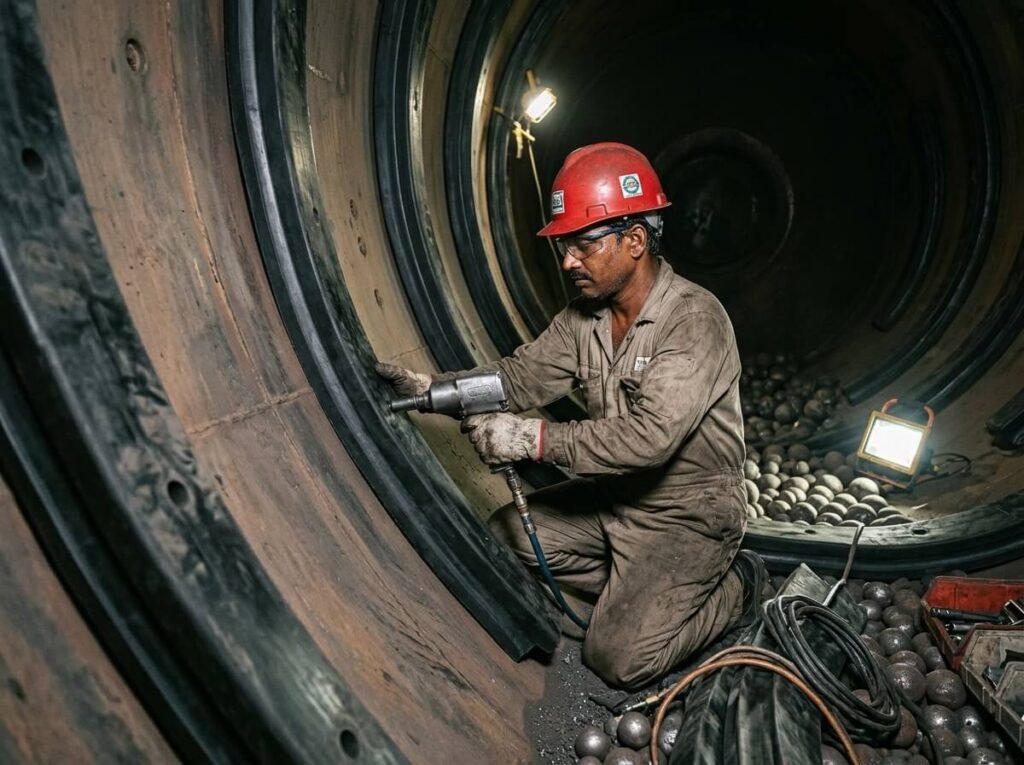
Our [Ball Mill Head Plate] Manufacturing Capabilities
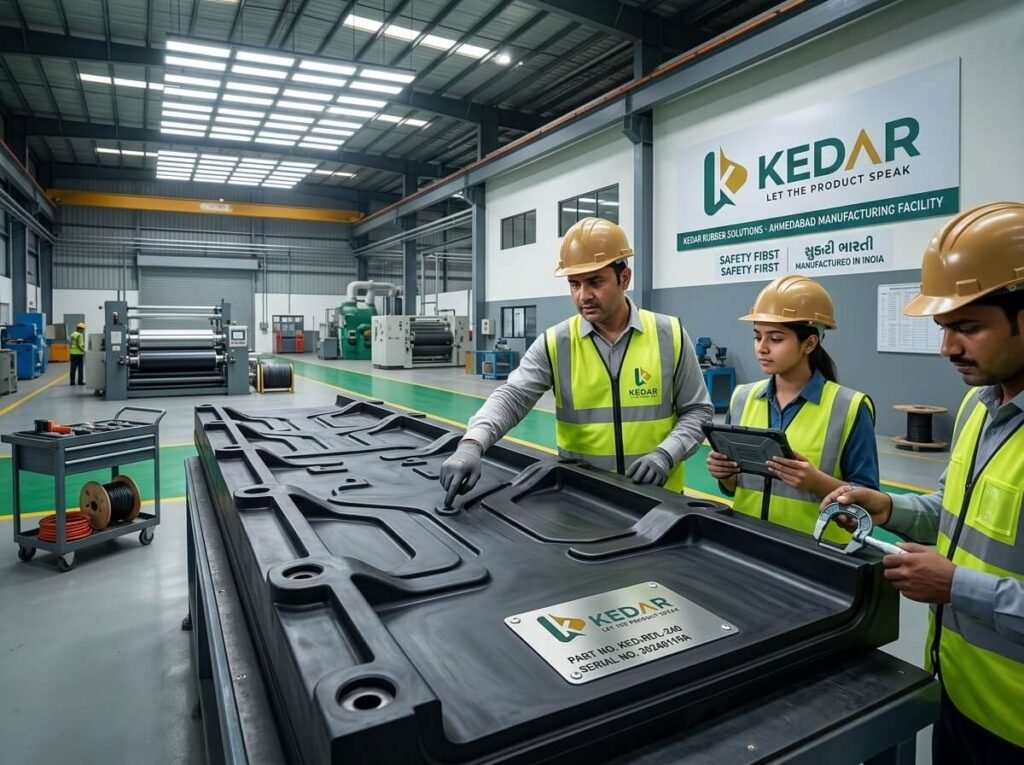
Manufacturing an industrial-grade rubber liner requires strict control over vulcanization, compound mixing, and mold precision. At our facility in Changodar, Ahmedabad, we utilize high-pressure compression molding techniques to ensure zero porosity in the finished product. This eliminates internal weak points that could lead to premature tearing under heavy impact. We process a variety of specialized synthetic and natural rubber blends to produce custom molded rubber products tailored to exact client requirements.
Our team understands that a cement mill in Rajasthan will face different abrasion profiles than a wet grinding circuit processing iron ore in Odisha. Therefore, every plate is reverse-engineered or modeled precisely to mill drawings. As dedicated Rubber Liner Manufacturers in Ahmedabad, our capability extends beyond just head plates. For material handling zones leading into the mill, installing a durable UHMW impact bar reduces the shock loading on conveyor transfer points, maintaining a steady feed rate without damaging auxiliary infrastructure. Our internal testing lab continuously monitors tensile strength, elongation at break, and Shore A hardness to guarantee consistency across every batch we produce.
Navigating Quality Standards & ISO 9001:2015 Certification
In heavy engineering, material failure is not just an inconvenience; it represents severe financial loss. Quality assurance must be deeply integrated into the production process, not treated as an afterthought. Adhering to the ISO 9001:2015 certification framework means that every stage of our production—from raw material inspection to final dimension checks—follows documented, traceable procedures. We maintain rigorous standards to deliver a longer life rubber liner that plant engineers can trust.
Testing for abrasion resistance, tear strength, and chemical compatibility ensures our liners withstand continuous slurry exposure without degrading. We routinely cross-reference our batch data with real-world wear profiles collected from clients across industrial belts like Indore and Hyderabad. This evidence-based approach removes the guesswork from maintenance planning. Working with a verified industrial rodmill lifter bar manufacturer and head plate supplier means your facility benefits from stringent QA protocols that match global manufacturing benchmarks.
Get a Quote for [Ball Mill Head Plate]
Local Manufacturers vs Kedar Rubber (Comparison Table)
Plant managers often weigh the options between unverified local workshops and specialized industrial manufacturers. The table below outlines the operational differences.
| Feature | Standard Local Suppliers | Kedar Rubber Standards |
|---|---|---|
| Material Formulation | Generic commercial rubber | Application-specific wear-resistant compounds |
| Quality Certification | Often uncertified | ISO 9001:2015 Certified |
| Weight Profile | Heavy, difficult to install | 65-75% lighter than steel equivalents |
| Noise Reduction | Minimal testing | Up to 70% reduction in operating noise |
| Customization Depth | Standardized molds only | Precise fit based on mill geometry |
Understanding the fundamentals of elastomeric protection is crucial. To dive deeper into the technical mechanics, explore how rubber liners improve ball mill performance and reduce overall structural fatigue.
Step-by-Step Process – How We Deliver [Ball Mill Head Plate]
The procurement of heavy-duty mining rubber liner systems requires a methodical approach to guarantee a perfect fit and optimum performance.
- Initial Assessment & Site Data Collection: We begin by analyzing your current mill drawing, grinding media size, RPM, and the material being processed. Our engineering team often conducts a “Free Rubber Liner Consultation” to assess existing wear patterns.
- Material Selection & Design: Based on the abrasive index of your material, we formulate the exact rubber compound required. A specialized cement mill liner needs different elasticity compared to one used for silica sand.
- Drafting & Approval: CAD drawings are generated to map the exact bolt hole alignments and thickness profiles, ensuring zero gaps during installation.
- Precision Molding: The approved design moves to our compression molding presses, where temperature and pressure are carefully calibrated to ensure uniform curing of the rubber.
- Quality Inspection: Post-curing, the plates undergo dimensional checks, hardness testing, and visual inspection.
- Dispatch & Installation Support: The lightweight nature of the plates ensures lower freight costs to locations like Kolkata or Delhi. We also provide clear guidelines to your maintenance teams for fast, secure fastening inside the mill.
By following this strict sequence, we stand out among Ball Mill Rubber Liner Manufacturers as a reliable technical partner rather than just a vendor. For facilities running multi-stage grinding, similar processes apply when sourcing a rodmill lifter bar in Morbi to ensure consistency across the entire plant.
Real Client Case Study
Mini Client Success Story: A mineral processing unit in Surat was experiencing recurring bolt shear and plate cracking with their metallic head liners, leading to a 12-hour unplanned shutdown every month. After retrofitting our custom rubber head plate, the facility recorded zero mid-cycle failures over an 18-month period, recovering over 200 hours of lost production time.
Detailed Case Study: Cement Plant Output Optimization in Jaipur
A prominent cement manufacturing facility in Jaipur faced significant operational bottlenecks. Their existing head plates were suffering from aggressive scouring due to the high silica content in their clinker feed. This rapid wear exposed the mill trunnion to damage, and the extreme noise levels were violating local industrial safety norms. They engaged us as their primary industrial rubber manufacturer Gujarat to diagnose and resolve the issue.
Our technical team analyzed the mill’s trajectory and identified that the impact zones were incorrectly managed by the rigid metallic plates. We engineered a customized, highly resilient rubber head plate using a proprietary impact-absorbing compound.
Results Achieved:
- Wear Life Extension: The new rubber liner outlasted the previous steel liners by 2.5 times, pushing their maintenance cycle from 8 months to 20 months.
- Acoustic Improvement: Ambient noise on the mill floor dropped by 62%, bringing the plant well within regulatory compliance.
- Downtime Reduction: Because the noise reduction rubber liner components were 70% lighter, the maintenance crew reduced their installation time by half, requiring fewer heavy-lifting overhead cranes.
If your plant is facing similar high-wear challenges, you can easily “Download Ball Mill Liner Cost Guide” via our contact page to evaluate the ROI of switching to engineered rubber solutions.
Frequently Asked Questions (FAQs)
1. What is the main function of a Ball Mill Head Plate?
The head plate protects the feed and discharge ends of the ball mill cylinder from the continuous impact and abrasion of grinding media and raw materials, preventing structural damage to the mill shell.
2. How much lighter is a rubber liner compared to a steel liner?
Our specially formulated rubber liners are typically 65% to 75% lighter than standard manganese or alloy steel liners, which significantly reduces the structural load on mill bearings and gears.
3. Yes, we provide custom sizing. How long does the customization process take?
Customizing a custom rubber liner Ahmedabad usually takes 2 to 4 weeks depending on the complexity of the mill dimensions, mold availability, and specific compound requirements.
4. Can rubber liners withstand high-temperature grinding environments?
Yes, while standard rubber has temperature limits, we manufacture heat-resistant rubber compounds designed specifically for dry grinding applications like cement mills where internal temperatures are elevated.
5. How does a rubber head plate contribute to noise reduction?
Rubber inherently absorbs kinetic energy and dampens vibrations. Replacing metal-to-metal impact with metal-to-rubber impact can drop ambient noise levels by up to 70%, creating a safer work environment.
6. Are rubber liners suitable for highly abrasive ores?
Absolutely. We engineer high-tear, wear-resistant elastomeric blends specifically formulated to handle highly abrasive materials found in iron ore, gold, and copper mining sectors.
7. How do I request a consultation for my plant?
You can reach out to our technical team directly via WhatsApp or by calling our factory at +91-98244 44733. We offer a “Free Rubber Liner Consultation” to review your current mill setup.