Industrial-Grade Feed Lifter Bar in Morbi: Kedar Rubber Products Pvt Ltd
In sectors like mining, metal refining, cement making, ceramics, and bulk material handling, the dependable performance of equipment isn’t just an ideal—it directly impacts output levels, operational safety, and cost management. In demanding industrial settings, rotating machinery and material transport systems endure constant rubbing, forceful impacts, damp conditions, and inconsistent feed material. These factors create predictable areas of wear that, if not properly engineered, become frequent points of breakdown. In these situations, a well-conceived Feed Lifter Bar in Morbi from KEDAR RUBBER PRODUCTS PVT LTD plays a vital role in managing material flow and safeguarding mill linings.
Process stoppages stemming from liner damage or inefficient material movement affect production timelines, worker well-being, and maintenance scheduling. Seasoned plant operators frequently note that downtime due to wear is seldom caused by a single incident; instead, it’s usually the combined result of mismatched wear protection materials, incorrect liner shaping, or inconsistent production quality.
Globally, the need for wear protection solutions is increasing alongside greater mineral extraction, expanded cement capacity, and larger bulk material movements. Within this context, the Feed Lifter Bar serves a crucial function inside ball mills and similar rotating units by controlling how material enters while preventing direct strikes and rubbing from reaching the shell liners. When expertly designed and maintained, it helps ensure steady milling action, managed wear patterns, and predictable service intervals.
Industry Hurdles Driving the Need for Feed Lifter Bars
In mining and metal processing, mills and conveyors face a mix of severe stresses:
- Friction: Hard mineral pieces and clinker continuously rub against lining surfaces.
- Impact Stress: Large incoming material drops into mill chambers, creating localized pressure points.
- Deterioration: Moisture, liquid mixtures, and added chemicals hasten material breakdown.
- Outage Pressure: Unexpected liner failures halt entire production sequences.
- Expense of Upkeep: Frequent liner swaps inflate labour needs and spare parts inventory.
Similar issues are seen in cement plants in certain states, ceramic hubs in others, and steel and power facilities across several regions. In all these settings, feed lifter bars must endure abrasive feed while maintaining their shape long enough to support consistent mill capacity.
Defining the Feed Lifter Bar
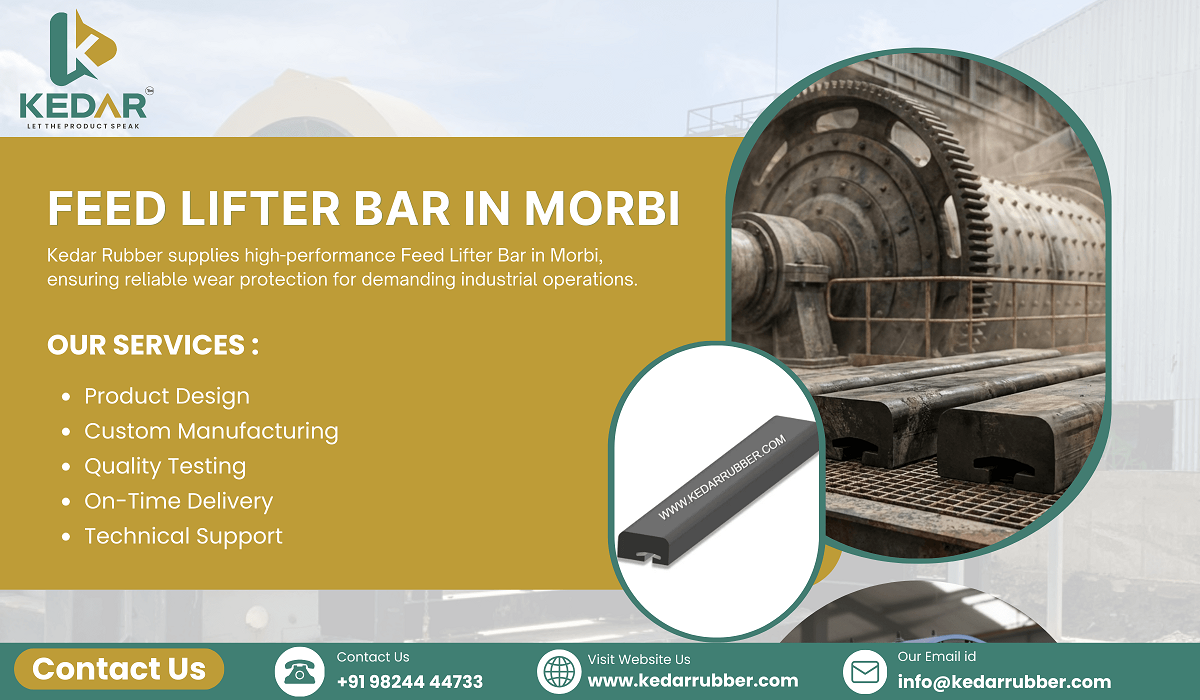
A feed lifter bar is a replaceable part that wears out and is fitted at the entry point of a ball mill or a comparable rotating machine. Its main job is to direct incoming material into the mill’s grinding zone while shielding the liner underneath from direct force and abrasive sliding.
From an engineering viewpoint, a feed lifter bar must:
- Maintain its intended shape under repeated mechanical force
- Absorb sudden impacts without shattering
- Resist wear from the material rubbing against it
- Stay true to its dimensions across operating temperatures
Unlike generic flat wear plates, feed lifter bars are geometrically critical components. Their form influences how material flows, which, in turn, affects grinding efficiency and the even wear of the liner.
Use Across Diverse Sectors
Feed lifter bars are employed wherever rotating mills or material channels are subjected to heavy feed impacts:
- Mining: At the ore entry points in ball mills and SAG mills
- Cement: In the raw material and clinker grinding circuits
- Metal & Steel: In slag grinding and mineral preparation lines
- Ceramic: In ball mills used for tile and sanitaryware items
- Power Plants: Within coal pulverizing setups
- Bulk Handling: In feed hoppers and transfer points connected to milling systems
In ceramic manufacturing centers across various states, feed lifter bars are often paired with ceramic wear shields in high-rubbing zones. In mineral-rich areas, rubber-based systems are favoured where absorbing shock is paramount.
Material Science and Engineering Factors
Choosing the right material is the fundamental engineering choice affecting feed lifter bar performance:
- Rubber Qualities: Rubber compounds allow elastic movement during impact, lessening stress transferred to the mill casings. Properly designed rubber resists tearing and stays flexible through repeated cycles.
- Ceramic Strength: Ceramic pieces offer excellent resistance to rubbing wear but require careful attachment and backing to avoid breaking under sudden force.
- Wear Resistance Principles: Wear is affected by particle hardness, speed, and contact angle. Feed lifter bars face both sliding friction and steep-angle impacts, requiring a balance between toughness and rigidity.
- Impact Dampening: In heavy-use industrial settings, flexible materials absorb energy, delaying the onset of cracks compared to rigid metal liners.
Producers with extensive industry tenure know that the material mix needs to be tailored to the specific workload, the feed size range, and the dampness conditions at each facility.
Design and Customization Needs
Feed lifter bars are not uniform items. Practical design considerations include:
- Machine Fit: Aligning bolt patterns, curve, and connection shape with specific mill models.
- Size Adaptation: Entry point dimensions differ between original manufacturers and upgraded mills.
- Task-Specific Shaping: Zones with heavy impact in mining require different contours than mills handling fine feed for ceramics.
Experienced plant maintenance staff often observe that an ill-suited lifter bar profile can lead to lopsided material distribution, causing faster liner deterioration further down the line.
Manufacturing Quality and Process Oversight
Industrial wear parts demand consistent quality across all production runs:
- Accurate Fabrication: Mould precision and dimensional adherence ensure proper seating and predictable wear marks.
- Quality Checks: Testing for hardness, visual inspection, and checking bond strength prevent early failures.
- Batch Uniformity: Changes in compound recipes can alter the lifespan and energy absorption capabilities.
Manufacturers serving demanding international markets are usually expected to provide clear documentation of material specifications and quality assurance procedures.
Fitting and Servicing Notes
From a maintenance perspective, feed lifter bars should:
- Allow for simple fitting using standard plant equipment
- Permit scheduled replacement timed with liner changeovers
- Minimize the time the machine is down during planned service
Well-designed rubber-based lifter bars often lessen handling hazards compared to heavier metal equivalents, promoting safer maintenance work.
Safety & Operational Dependability
Wear defence mechanisms directly contribute to:
- Personnel Safety: Fewer liner failures reduce the risk of loose debris in grinders.
- Asset Shielding: Damping shock forces, safeguards, shell coverings, and the mill framework.
- Facility Uptime: Steady material passage lessens process variations and unusual shuddering.
In resource extraction and metal refining activities, liner soundness is a fundamental aspect of the secure operation of grinding equipment.
Cost Effectiveness Throughout Equipment Service Life
While individual parts constitute only a portion of total plant expenditure, feed lifter projections impact:
- Extended Maintenance Strategy: Foreseeable wear streamlines shutdown scheduling.
- Fewer Unexpected Interruptions: Dependable parts limit sudden repair needs.
- Maintenance Streamlining: Coordinated cover replacement lessens worker exposure and logistical hassle.
Service life effectiveness is achieved through material choice, design precision, and production uniformity—not through unreasonable longevity guarantees.
Export Suitability & Worldwide Acceptance
Industrial purchasers across Africa, the Middle East, Southeast Asia, and Australia anticipate:
- Explicit technical papers
- Knowledge of international standard benchmarks
- Dependable supply chain and lot tracking
Vendors supporting worldwide ventures must harmonize production and quality methods with these expectations.
Value of Seasoned Manufacturers
Feed lifter bars function within intricate mechanical setups. Engineering skills and practical background are valuable because:
- Wearing patterns diverge across ore types and operational states
- Erection methods affect performance under real conditions
- Ongoing input from facility operators drives design betterment
Producers with extensive industry background recognize that performance figures from running plants are as crucial as controlled lab assessments.
Regarding KEDAR RUBBER PRODUCTS PVT LTD
KEDAR RUBBER PRODUCTS PVT LTD is an Indian manufacturing enterprise supplying grinding mill rubber facings, composite wear defence options, rubber sheathing systems, rubber grinding apparatus items, and conveying solutions to resource, cement, metal, ceramic, energy, and bulk material transit sites. With involvement across all of India and overseas venues, the firm addresses wear defence demands in mineral-rich locales such as Odisha, Jharkhand, Chhattisgarh, Rajasthan, Gujarat, Maharashtra, Andhra Pradesh, Telangana, Karnataka, and Tamil Nadu.
Further technical specifics about their offerings and production capacities are viewable at 👉 https://www.kedarrubber.com/
Summary
The feed lifter bar is a minor yet structurally vital element in grinding mills and bulk material transport groupings. Its function in governing material passage, absorbing kinetic energy, and safeguarding lower shields directly affects facility dependability and upkeep planning. In demanding industrial settings, appropriately designed wear elements support steady operations and predictable downtime intervals. Choosing and servicing feed lifter bars based on actual process circumstances—rather than general specifications—remains a pragmatic approach to boosting long-term apparatus performance.
Core Insights
- Feed lifter bars regulate material movement and safeguard mill facings
- Appropriate abrasion control enhances operational consistency
- Suitable for mining, cement, metal, ceramic, energy, and bulk transit sectors
- Enduring functionality relies on material science and design exactness
- Global industry relevance necessitates uniform production quality
Current Inquiries
Q1: What is the usual service duration for a feed lifter bar in commercial mills?
Service life varies with input size, mineral density, and runtime. In resource extraction and metal refining, wear rates are higher due to impact loading and abrasive particles.
Q2: Are feed lifter bars appropriate for both wet and dry grinding processes?
Affirmative, yet material selection and compound makeup must match moisture and slurry chemical conditions.
Q3: How frequently should feed lifter bars be checked?
Knowledgeable facility technicians frequently find that checks coinciding with cover shutdown periods help spot uneven wear before functional capability declines.
Q4: Rubber compared to composite wear solutions – which excels for feed sections?
Rubber provides better shock damping, whereas composite offers superior abrasion resistance. Mixed setups are sometimes employed in high-wear, moderate-shock segments.
Q5: Are feed lifter bars utilized worldwide in mining and cement facilities?
Indeed, they are standard elements in grinding mills across global mining, cement, and mineral processing installations.
#BallMillRubberLiner #CeramicWearProtection #RubberLining #MiningSolutions #BulkMaterialHandling #ConveyorSolutions #kedarrubberproduct #WearProtection #IndustrialManufacturing