
Radial Shell Plates in Ball Mills: Understanding Wear Protection That Actually Works in Heavy-Duty Industrial Environments
Introduction
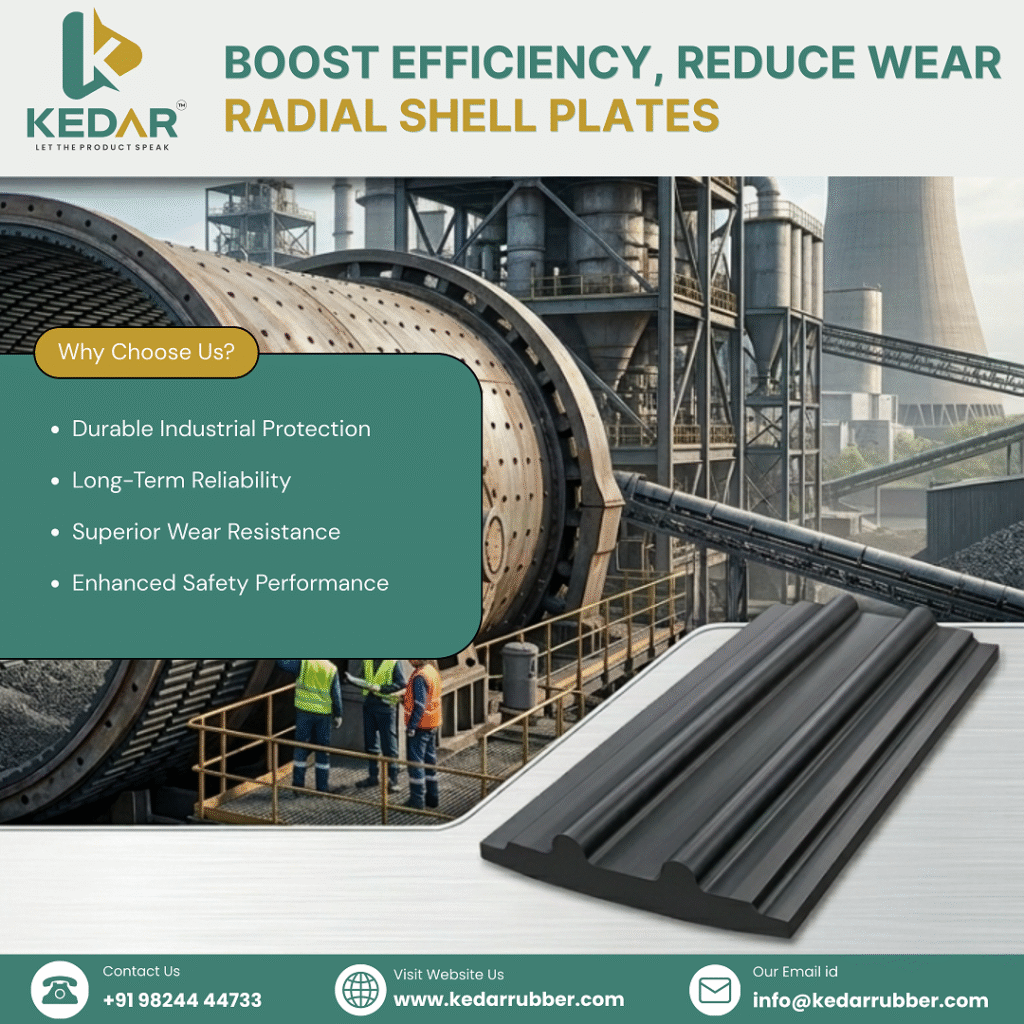
Across mining sites in Rajasthan and Jharkhand, cement plants in Gujarat and Maharashtra, steel processing units in Odisha and Chhattisgarh, and ceramic manufacturing clusters radial shell plates in Morbi, plant engineers face a common challenge—equipment wears out faster than expected, and unplanned downtime strains maintenance budgets. Improve Operational Efficiency with Radial Shell Plates by enhancing durability and reducing wear in critical operations. Kedar Rubber Products Pvt Ltd delivers reliable, high-performance solutions designed to maximize productivity and minimize operational disruptions across industries.
Ball mills sit at the center of this challenge. These machines run continuously under extreme conditions — grinding hard ores, clinker, ceramic raw materials, and other abrasive feed stocks. The internal shell takes relentless punishment from both the grinding media and the material being processed.
This is where radial shell plates become a critical engineering solution. Their design, material selection, and dimensional fit directly determine how long a mill runs before the next maintenance window — and how much it costs to keep it running.
Industrial Challenges That Drive Demand for Radial Shell Plates
In heavy-duty industrial environments, four problems consistently drive premature equipment failure:
- Abrasion is the most persistent. Hard mineral particles — iron ore, limestone, quartz, feldspar — continuously scour internal mill surfaces. Over time, even hardened steel liners lose material, leading to shell exposure and structural risk.
- Impact loads compound the problem. As the mill rotates, grinding balls cascade against the shell with significant force. This repeated impact across continuous operation schedules fatigues liner materials, causing cracking, chipping, or bolt loosening.
- Corrosion accelerates degradation further, particularly in wet grinding circuits common in mineral processing. Slurry chemistry, moisture, and temperature fluctuations wear surfaces beyond what abrasion alone would cause.
- Downtime and maintenance costs are the downstream consequences. Experienced plant engineers often observe that a single unplanned mill stoppage — accounting for lost production, emergency labor, crane hire, and liner replacement — costs multiples of what a proper liner system would have across its full service cycle.
What Is a Radial Shell Plate?
A radial shell plate is a precision-engineered wear liner panel mounted along the cylindrical shell of a ball mill, following the radial (circular) profile of the drum. Unlike flat plates, radial shell plates are curved to match the internal geometry of the mill shell exactly, ensuring full surface contact and structural support.
They are manufactured from natural rubber compounds, synthetic rubber blends, or rubber-ceramic composites, depending on the grinding application. The radial curvature determines how effectively the liner transfers impact forces to the shell without creating stress concentration points that cause cracking or bolt failure.
A well-designed radial shell plate does two things simultaneously: it protects the mill shell from direct contact with grinding media, and it influences how the internal charge cascades — which directly affects grinding efficiency.
Applications Across Industries
- Mining: In iron ore, copper, gold, and coal processing plants across Goa, Odisha, Chhattisgarh, and Rajasthan, ball mills run in continuous duty with highly abrasive feed. Radial shell plates here require high wear resistance with adequate impact absorption.
- Cement: Cement grinding mills in Gujarat, Andhra Pradesh, and Rajasthan process clinker and additives that cause both abrasive and impact wear. Rubber radial shell plates are commonly preferred in finish grinding for noise reduction and ease of replacement.
- Metal & Steel: Secondary grinding in pelletization plants and slag processing units in Odisha, Karnataka, and West Bengal requires liners that handle dense, heavy grinding media with emphasis on impact resistance.
- Ceramics: Ceramic clusters in Morbi, Gujarat rely on ball mills for grinding glaze materials and body compositions. Rubber liners are preferred here to avoid introducing metallic contamination into the product stream.
- Power Plants & Bulk Handling: Bottom ash handling circuits in thermal power plants across Madhya Pradesh, Maharashtra, and Tamil Nadu, and conveyor transfer chute applications in bulk material handling, benefit from wear protection that extends equipment service intervals.
Beyond the Mill: Complete Wear Protection Solutions Under One Roof
Radial shell plates are one part of a broader wear protection ecosystem. Kedar Rubber Products Pvt Ltd also manufactures:
- Ball Mill Rubber Liners: head liners, grate plates, and discharge liners for full mill interior protection
- Ceramic Wear Protection Tiles: alumina ceramic bonded on rubber backing for chutes, hoppers, and cyclone liners in high-abrasion zones
- Rubber Lining Systems: for tanks, vessels, and pipes in corrosive slurry and wet processing environments
- Conveyor Belt Solutions: impact bars, wear liners, and skirting systems for bulk material handling transfer points
One experienced manufacturer. Coordinated wear protection across your entire plant.
Material Science & Engineering Considerations
The performance of a radial shell plate depends on material properties matched to the specific grinding environment.
Natural rubber offers excellent resilience and impact absorption. Its elastic recovery — the ability to deform under impact and return to shape — dissipates energy from grinding ball impacts rather than transmitting it to the mill shell. This is why rubber liners frequently outlast steel in lower-to-medium abrasion, high-impact applications.
Synthetic rubber compounds: SBR, EPDM, neoprene — extend performance into environments with chemical exposure, elevated temperature, or specific hardness requirements. Compound selection balances Shore A hardness against elongation-at-break properties.
Ceramic wear inserts: typically alumina (Al₂O₃) at 92% or 95% purity — are bonded into rubber backing plates where abrasion is severe but some impact absorption is still required. The ceramic handles surface wear; the rubber absorbs shock and secures the assembly.
Wear resistance is not purely a function of hardness. The relationship between hardness, toughness, and bond integrity governs real-world service life. A ceramic tile improperly bonded to its rubber substrate will delaminate under cyclic loading regardless of surface rating.
Design, Manufacturing & Quality Control
No two ball mills are dimensionally identical. Liner design must account for shell diameter, mill length, bolt pattern, grinding media size, charge volume, feed material hardness (Mohs scale), and operational speed as a percentage of critical speed.
Custom sizing is a baseline requirement for radial shell plates, not an exception. Standard catalog sizes rarely provide the geometric fit needed for correct liner function.
On the manufacturing side, consistent field performance begins with controlled processes: rubber compounding consistency (batch-to-batch variation in compound formulation affects hardness, cure state, and wear resistance), precise vulcanization control (time, temperature, pressure determine cross-link density), tight dimensional accuracy in radial curvature and bolt hole pattern, and bond integrity testing for ceramic-rubber composite plates.
Quality control at this level requires dedicated tooling, calibrated curing presses, and documented batch records.
For more industry insights and global business updates, visit Forbes to explore trusted expert analysis and reports.
Installation, Maintenance & Safety
Radial shell plates are installed using through-shell bolts with rubber or steel backing plates. A well-planned liner change on a medium-sized ball mill fits within a standard maintenance shutdown when the maintenance team pre-stages the replacement liner set and prepares the crew in advance.
The maintenance team must follow bolt torque specifications precisely, as under-torqued bolts allow liner movement, while over-torqued bolts risk damaging rubber through excessive compression. Liner sequencing during installation ensures the full set locks into radial position correctly.
Wear monitoring through periodic shell thickness measurements during planned shutdowns enables proactive replacement before liner failure reaches the shell. The maintenance team typically plans rubber liner systems in standard grinding applications on an 8,000–15,000 hour cycle, and ore hardness and mill loading govern this cycle.
From a safety standpoint, a reliable liner system reduces the frequency of mill internals inspections, which carry confined-space entry risks. Visit our contact page to connect with our team and get quick assistance for your inquiries and project needs related to liner specifications and industrial applications.
Cost Efficiency & Export Readiness
The true cost of a liner system must be evaluated over its service life, not by unit price alone. A lower-cost liner requiring replacement 30% more frequently typically costs more in aggregate when production loss, labor, crane hire, and consumables are factored in. Procurement managers evaluate liner specifications—material grade, accuracy, and bond quality—over a 3–5 year planning cycle.
For manufacturers supplying international markets — Southeast Asia, Africa, the Middle East, Australia — material test certificates, dimensional inspection reports, vulcanization batch records, and ISO quality management compliance are baseline expectations. Plants in Zambia, Indonesia, or Chile require the same documentation package as a plant in Jharkhand or Rajasthan.
Why Experienced Manufacturers Matter
Wear protection is a technically demanding product category. The difference between a liner that performs to specification and one that fails early lies in compound development experience, tooling investment, process discipline, and the ability to translate operational data into a correct liner specification. Manufacturers with engineering depth review mill drawings, discuss grinding circuit parameters, and recommend liner profiles — not just supply catalog items.
For business growth strategies and startup insights, visit Entrepreneur to explore expert articles and success stories.
About Kedar Rubber Products Pvt Ltd
Kedar Rubber Products Pvt Ltd is an established industrial manufacturer with deep experience across ball mill rubber liners, ceramic wear protection solutions, rubber lining systems, and conveyor wear components. The company serves mining, cement, ceramic, metal processing, and bulk material handling industries across India — from Gujarat and Rajasthan to Odisha, Maharashtra, Tamil Nadu, Karnataka, Andhra Pradesh, Madhya Pradesh, Chhattisgarh, West Bengal, Jharkhand, Telangana, Punjab, Haryana, Uttarakhand, and beyond — as well as international industrial markets.
With a focus on engineering accuracy and application-specific design, Kedar Rubber Products supports plant engineers, maintenance teams, procurement managers, and EPC contractors with technically sound wear protection solutions.
👉 Learn more at https://www.kedarrubber.com/
Conclusion
Radial shell plates are not passive components. In a ball mill, they actively manage energy distribution across the shell, determine how long the equipment runs between shutdowns, and influence grinding circuit consistency. Getting them right — in material selection, dimensional accuracy, and manufacturing quality — has direct, measurable impact on plant efficiency and long-term maintenance economics.
For plant teams evaluating wear protection options, begin with a clear understanding of the application: ore hardness, mill geometry, operational speed, and maintenance philosophy. The right liner specification follows from there.
Contact us for expert technical support, product details, and tailored industrial solutions based on your requirements.
Key Takeaways
- Radial shell plates protect ball mill shells from abrasive and impact wear while influencing grinding charge motion
- Rubber, rubber-ceramic composite, and ceramic-backed systems suit different wear profiles — match the solution to abrasion vs. impact severity
- Dimensional accuracy and radial fit are non-negotiable for correct liner function
- Manufacturing consistency — compound quality, cure control, bond integrity — directly determines field performance
- Total lifecycle cost, not unit price, is the correct metric for liner procurement
Frequently Asked Questions
Q1. What is the typical service life of a radial shell plate?
In standard mineral grinding applications, rubber radial shell plates typically last 8,000 to 15,000 operating hours. Harder, more abrasive applications may require ceramic-composite plates with different wear characteristics.
Q2. How do I choose between rubber and ceramic wear protection?
Rubber suits high-impact, moderate-abrasion environments. Ceramic or rubber-ceramic composite is better where surface abrasion dominates and impact load is manageable. A material selection review based on ore hardness and mill parameters guides the decision.
Q3. Can radial shell plates be made for non-standard mill sizes?
Yes. Radial shell plates must match each mill’s specific shell diameter, bolt pattern, and lifting bar profile. Manufacturers like Kedar Rubber Products Pvt Ltd offer custom manufacturing as standard practice, not an exception, ensuring precise fit across varying ball mill configurations.
Q4. What documentation should a manufacturer provide?
Material test certificates, dimensional inspection reports, vulcanization batch records, bond adhesion test results (for ceramic composite plates), and ISO quality system documentation for international supply.
Q5. Are rubber liners suitable for wet grinding circuits?
Yes. Natural and synthetic rubber compounds resist water absorption and perform reliably in slurry environments. Kedar Rubber Products Pvt Ltd manufactures rubber liners with compound formulations suited to varying slurry pH levels and temperature conditions, making them a dependable choice for wet grinding applications across mining and mineral processing industries.
#BallMillRubberLiner #CeramicWearProtection #RubberLining #MiningSolutions #BulkMaterialHandling #ConveyorSolutions #kedarrubberproduct #WearProtection #IndustrialManufacturing